
Abstract
This research analyzes academic journal articles in Pakistan by exploring their linguistic variations in different sections through multidimensional analysis. The analysis identifies the language of Pakistani academic journal articles. The corpus of Pakistani academic journal articles has been culled from a variety of research articles published in Pakistani academic journals. The data have been analyzed along five dimensions of Biber’s (1988) Multidimensional analysis model. The ANOVA result of Pakistani academic journal articles reveals significant differences among research sections of journal articles along Biber’s five dimensions. The finding describes the nature of Pakistani academic journal research articles as informational, impersonal, non-narrative, elaborated, explicit, and non-persuasive.
Key Words
English language variation, Academic register, Academic Journal Research Articles, Multidimensional Analysis
Introduction
English language variation has remained an interesting subject. For the academic community its importance is undeniable to transfer the up-to-date knowledge in the best appropriate language choices. The research on variations in academic writing has been contributed by many researchers, (Moore, 2002; Moran, 2013; Qasim, and Shakir, 2016). Research articles have been studied from perspective of organizational pattern mostly (Swales, 1990; Salager-Meyer, 1992a, 1992b; Hyland, 1996; Samraj, 2005; Zhen-ye, 2008; Stoller and Robinson 2013). Only a single genre-based study has been conducted on research articles so far in Pakistan (Aslam and Mahmood, 2016). This study explores the organizational pattern of a few Pakistani research articles but in the academic register of research articles a multidimensional approach has not been applied in the Pakistani context yet. Thus this study has been designed to fulfill this research need.
The multidimensional model (first introduced by Biber (1988) to study 23 spoken and written genres) has been utilized as a suitable tool for register variation studies by researchers (Biber & Finegan, 1994; Conrad, 1996; Knoksilapathom, 2003; Getkham, 2010; Gray, 2013; Egbert, 2015). Following the tradition two Academic registers have been studied for the analyses of language variations through multidimensional perspectives in Pakistan (Abdulaziz, Mahmood and Azher, 2016; Azher and Mahmood, 2016). The most important academic register of journal articles yet need to be explored as research articles have not yet been studied in Pakistani context. Resultantly, this research has been designed to explore the language of Pakistani Journal research articles along Biber’s (1988) five dimensions to see the textual dimensions in Academic Journals in Pakistan. Biber’s 5 textual dimensions are discussed in the following paragraphs.
Dimension 1 is the basic linguistic dimension as it includes most of the linguistic features. It consists of private verbs, adverbs, contractions, first person pronouns, pronoun it, general emphatics, demonstrative pronouns, be as main verb, analytical negation, do as pro-verb, second person pronouns, present tense verbs, THAT deletion, final prepositions, WH- clauses, non-phrasal coordination, possibility modals, WH- questions, sentence relatives, amplifiers, general hedges, indefinite pronouns, discourse particles, causative subordination, on the positive pole. On the other hand, the negative pole consists of nouns, post-nominal clauses, agentless passives, place adverbials, attributive adjectives, type/token ratio, prepositions and word length. The negative features are related to informational function while, the positive features are used in interactive discourse so, they are associated with interactive and involved function. This dimension is named by Biber as “Involved vs. informational production”. Dimension 2 consists of positive features like past tense verbs, present participial clauses, syntactic negation, public verbs, perfect aspect verbs, third person pronouns and negative features like attributive adjectives and present tense verbs. The positive features convey a narrative function in this dimension and the negative features convey a non-narrative or descriptive function. Biber (1988) named it as “Narrative vs. non narrative discourse”. Biber labeled dimension 3 as “Elaborated vs. situation-dependent reference”. Wh-relative clauses on object positions, nominalizations, phrasal coordination, wh-relative clauses on subject positions, pied-piping constructions are positive and adverbs, place adverbials, time adverbials are negative features. Negative features underlie the situation dependent and temporal texts while, elaborated function have been shared by positive features. Dimension 4 labeled by Biber as the overt expression of argumentation/persuasion comprises of the positive features as infinitives, split auxiliaries, conditional subordination, necessity modals, prediction modals, possibility modals and persuasive verbs. While, it has no negative feature, the function of linguistic features in this dimension is persuasion. Conjuncts, other adverbial subordinators, past participial post nominal clauses, by- passives, past participial adverbial clauses, agent less passives are only positive features with no negative features in fifth dimension. These linguistic features share formal and abstract and other type of discourse. Abstract vs. non abstract information/style is the name given to fifth dimension. The detail of the analysis and dimensions is given in following section.
Literature Review
English language variation has remained an interesting subject. For the academic community its importance is undeniable to transfer the up-to-date knowledge in the best appropriate language choices. The research on variations in academic writing has been contributed by many researchers, (Moore, 2002; Moran, 2013; Qasim, and Shakir, 2016). Research articles have been studied from perspective of organizational pattern mostly (Swales, 1990; Salager-Meyer, 1992a, 1992b; Hyland, 1996; Samraj, 2005; Zhen-ye, 2008; Stoller and Robinson 2013). Only a single genre-based study has been conducted on research articles so far in Pakistan (Aslam and Mahmood, 2016). This study explores the organizational pattern of a few Pakistani research articles but in the academic register of research articles a multidimensional approach has not been applied in the Pakistani context yet. Thus this study has been designed to fulfill this research need.
The multidimensional model (first introduced by Biber (1988) to study 23 spoken and written genres) has been utilized as a suitable tool for register variation studies by researchers (Biber & Finegan, 1994; Conrad, 1996; Knoksilapathom, 2003; Getkham, 2010; Gray, 2013; Egbert, 2015). Following the tradition two Academic registers have been studied for the analyses of language variations through multidimensional perspectives in Pakistan (Abdulaziz, Mahmood and Azher, 2016; Azher and Mahmood, 2016). The most important academic register of journal articles yet need to be explored as research articles have not yet been studied in Pakistani context. Resultantly, this research has been designed to explore the language of Pakistani Journal research articles along Biber’s (1988) five dimensions to see the textual dimensions in Academic Journals in Pakistan. Biber’s 5 textual dimensions are discussed in the following paragraphs.
Dimension 1 is the basic linguistic dimension as it includes most of the linguistic features. It consists of private verbs, adverbs, contractions, first person pronouns, pronoun it, general emphatics, demonstrative pronouns, be as main verb, analytical negation, do as pro-verb, second person pronouns, present tense verbs, THAT deletion, final prepositions, WH- clauses, non-phrasal coordination, possibility modals, WH- questions, sentence relatives, amplifiers, general hedges, indefinite pronouns, discourse particles, causative subordination, on the positive pole. On the other hand, the negative pole consists of nouns, post-nominal clauses, agentless passives, place adverbials, attributive adjectives, type/token ratio, prepositions and word length. The negative features are related to informational function while, the positive features are used in interactive discourse so, they are associated with interactive and involved function. This dimension is named by Biber as “Involved vs. informational production”. Dimension 2 consists of positive features like past tense verbs, present participial clauses, syntactic negation, public verbs, perfect aspect verbs, third person pronouns and negative features like attributive adjectives and present tense verbs. The positive features convey a narrative function in this dimension and the negative features convey a non-narrative or descriptive function. Biber (1988) named it as “Narrative vs. non narrative discourse”. Biber labeled dimension 3 as “Elaborated vs. situation-dependent reference”. Wh-relative clauses on object positions, nominalizations, phrasal coordination, wh-relative clauses on subject positions, pied-piping constructions are positive and adverbs, place adverbials, time adverbials are negative features. Negative features underlie the situation dependent and temporal texts while, elaborated function have been shared by positive features. Dimension 4 labeled by Biber as the overt expression of argumentation/persuasion comprises of the positive features as infinitives, split auxiliaries, conditional subordination, necessity modals, prediction modals, possibility modals and persuasive verbs. While, it has no negative feature, the function of linguistic features in this dimension is persuasion. Conjuncts, other adverbial subordinators, past participial post nominal clauses, by- passives, past participial adverbial clauses, agent less passives are only positive features with no negative features in fifth dimension. These linguistic features share formal and abstract and other type of discourse. Abstract vs. non abstract information/style is the name given to fifth dimension. The detail of the analysis and dimensions is given in following section.
Research Methodology
This section revolves around the detail of the research methodology used in this research paper. Multidimensional analysis proposed by Biber has been utilized in current research for the analysis of Pakistani Academic Journal rticles. A corpus has been compiled for the current research. The detail of the corpus compilation and data analysis is given below.
Pakistani Research Articles Corpus (PRAC) Compilation process
Academic research articles have been selected from academic Pakistani journals. First the Journals have been downloaded from university archives and Pakistani Higher Education Commission website. The categories of research articles have been made on the basis of research articles sections. The data has been given the title Pakistani research articles corpus (PRAC). The research articles have been selected from various academic disciplines. The data has been categorized according to different categories made for the current research. The categories have been made according to research sections found in Academic Pakistani Journals Research articles. The research sections have been assigned with codes.
Table 1. Selected Research Sections for PRAC and the Assigned Codes
| S.N width="398">Sub-Categories of Pakistani Research Articles in terms of Sections width="54">Codes | > 1 width="398" valign="top">Abstract width="54" valign="top">1/A | > 2 width="398" valign="top">Introduction width="54" valign="top">2/I | > 3 width="398" valign="top">Literature Review width="54" valign="top">3/L | > 4 width="398" valign="top">Research Methodology width="54" valign="top">4/M | > 5 width="398" valign="top">Data Analysis width="54" valign="top">5/D | > 6 width="398" valign="top">Conclusion width="54" valign="top">6/C |
Data Analysis
The data analysis consist of the steps of tagging, linguistic counts, calculating dimension score and ANOVA. After the compilation of the data it was sent to North Arizona University for Tagging and running of Biber’s (1988) Tagger on Pakistani research articles corpus. The data has been tagged by Professor Egbert. (See Biber et al., 1999 for linguistic features). The linguistic features frequencies have been counted by utilizing Biber’s TagCount program. After the calculation the linguistic frequencies have been normalized. Biber set the criteria of normalizing the counts to per thousand words and the same has been followed here. After normalization the counts have been standardized and it is essential for the equal weight for all features. After the standardization, subtraction of the negative features standardized scores out of the sum of positive features standardized scores has been done for the calculation of the dimension score of individual text. An ANOVA test has been conducted to see statistically significant variations in different sections of research articles. The purpose of the ANOVA test is important to address the main question of the research, what and how much differences exist across the research sections of Pakistani research articles.
Results and Discussion
This section consists of result and discussion on multidimensional analysis of Pakistani Academic Research Journals Articles along five dimensions of multidimensional analysis.
ANOVA for Variation across Research Sections on Biber’s 1988 Dimensions
The first section highlights the result of multidimensional analysis of Academic Journal articles sections along Biber’s five dimensions. An analysis of variance (AVONA) test has been applied and resulting scores reveal significant statistical differences among research sections of Articles published in Pakistani Academic Journal. The ANOVA results exhibits statistical significant linguistic differences among different research sections on dimension 1 as mentioned in table below.
Table 1. ANOVA for Variation across Categories on D-1
| Dependent Variable: 1988_1 | > Source width="89">Type III Sum of Squares width="50">df width="72">Mean Square width="60">F width="48">Sig. width="65">Partial Eta Squared | > Corrected Model width="89">112547.526a width="50">204 width="72">551.704 width="60">15.768 width="48">.000 width="65">.273 | > Intercept width="89">244914.518 width="50">1 width="72">244914.518 width="60">6999.970 width="48">.000 width="65">.449 | > Discipline width="89">1.448 width="50">1 width="72">1.448 width="60">.041 width="48">.839 width="65">.000 | > Subject width="89">28971.871 width="50">26 width="72">1114.303 width="60">31.848 width="48">.000 width="65">.088 | > Section width="89">13182.279 width="50">7 width="72">1883.183 width="60">53.824 width="48">.000 width="65">.042 | > Discipline * Subject width="89">.000 width="50">0 width="72">. width="60">. width="48">. width="65">.000 | > Discipline * Section width="89">.000 width="50">0 width="72">. width="60">. width="48">. width="65">.000 | > Table Continued on Next Page | > Table Continued from Previous Page | > Subject * Section width="89">16431.139 width="50">150 width="72">109.541 width="60">3.131 width="48">.000 width="65">.052 | > Discipline * Subject * Section width="89">.000 width="50">0 width="72">. width="60">. width="48">. width="65">.000 | > Error width="89">300126.550 width="50">8578 width="72">34.988 width="60" valign="top">width="48" valign="top"> width="65" valign="top">
| > Total width="89">5471897.598 width="50">8783 width="72" valign="top">width="60" valign="top"> width="48" valign="top"> width="65" valign="top">
| > Corrected Total width="89">412674.076 width="50">8782 width="72" valign="top">width="60" valign="top"> width="48" valign="top"> width="65" valign="top">
| > a. R Squared = .273 (Adjusted R Squared = .255) | ||||||||||||||||||||||||
The ANOVA results exhibit statistically significant linguistic differences among different research sections on dimension 2 as described in table below.
Table 2. ANOVA for Variation across Categories on D-2
| Dependent Variable: 1988_2 | > Source width="73">Type III Sum of Squares width="51">Df width="70">Mean Square width="54">F width="51">Sig. width="73">Partial Eta Squared | > Corrected Model width="73">2797.914a width="51">204 width="70">13.715 width="54">5.844 width="51">.000 width="73">.122 | > Intercept width="73">3824.244 width="51">1 width="70">3824.244 width="54">1629.495 width="51">.000 width="73">.160 | > Discipline width="73">.351 width="51">1 width="70">.351 width="54">.150 width="51">.699 width="73">.000 | > Subject width="73">525.495 width="51">26 width="70">20.211 width="54">8.612 width="51">.000 width="73">.025 | > Section width="73">131.172 width="51">7 width="70">18.739 width="54">7.985 width="51">.000 width="73">.006 | > Discipline * Subject width="73">.000 width="51">0 width="70">. width="54">. width="51">. width="73">.000 | > Discipline * Section width="73">.000 width="51">0 width="70">. width="54">. width="51">. width="73">.000 | > Subject * Section width="73">680.360 width="51">150 width="70">4.536 width="54">1.933 width="51">.000 width="73">.033 | > Discipline * Subject * Section width="73">.000 width="51">0 width="70">. width="54">. width="51">. width="73">.000 | > Error width="73">20131.611 width="51">8578 width="70">2.347 width="54" valign="top">width="51" valign="top"> width="73" valign="top">
| > Total width="73">97762.010 width="51">8783 width="70" valign="top">width="54" valign="top"> width="51" valign="top"> width="73" valign="top">
| > Corrected Total width="73">22929.525 width="51">8782 width="70" valign="top">width="54" valign="top"> width="51" valign="top"> width="73" valign="top">
| > a. R Squared = .122 (Adjusted R Squared = .101) | ||||||||||||
The ANOVA results exhibits statistically significant linguistic differences among different research sections on dimension 3 as shown in table below.
Table 3. ANOVA for Variation across Categories on D-3
| Dependent Variable: 1988_3 | > Source width="73">Type III Sum of Squares width="51">Df width="70">Mean Square width="57">F width="48">Sig. width="73">Partial Eta Squared | > Corrected Model width="73">26277.154a width="51">204 width="70">128.810 width="57">7.649 width="48">.000 width="73">.154 | > Intercept width="73">32242.586 width="51">1 width="70">32242.586 width="57">1914.624 width="48">.000 width="73">.182 | > Discipline width="73">10.204 width="51">1 width="70">10.204 width="57">.606 width="48">.436 width="73">.000 | > Subject width="73">9126.801 width="51">26 width="70">351.031 width="57">20.845 width="48">.000 width="73">.059 | > Section width="73">1971.880 width="51">7 width="70">281.697 width="57">16.728 width="48">.000 width="73">.013 | > Discipline * Subject width="73">.000 width="51">0 width="70">. width="57">. width="48">. width="73">.000 | > Discipline * Section width="73">.000 width="51">0 width="70">. width="57">. width="48">. width="73">.000 | > Subject * Section width="73">4334.443 width="51">150 width="70">28.896 width="57">1.716 width="48">.000 width="73">.029 | > Discipline * Subject * Section width="73">.000 width="51">0 width="70">. width="57">. width="48">. width="73">.000 | > Error width="73">144454.960 width="51">8578 width="70">16.840 width="57" valign="top">width="48" valign="top"> width="73" valign="top">
| > Total width="73">776490.550 width="51">8783 width="70" valign="top">width="57" valign="top"> width="48" valign="top"> width="73" valign="top">
| > Corrected Total width="73">170732.114 width="51">8782 width="70" valign="top">width="57" valign="top"> width="48" valign="top"> width="73" valign="top">
| > a. R Squared = .154 (Adjusted R Squared = .134) | ||||||||||||
The ANOVA results exhibits statistically significant linguistic differences among different research sections on dimension 4 as displayed in table below.
Table 4. ANOVA for Variation across Categories on D-4
| Dependent Variable: 1988_4 | > Source width="66">Type III Sum of Squares width="36">Df width="60">Mean Square width="54">F width="42">Sig. width="60">Partial Eta Squared | > Corrected Model width="66">9650.475a width="36">204 width="60">47.306 width="54">6.217 width="42">.000 width="60">.129 | > Intercept width="66">5739.701 width="36">1 width="60">5739.701 width="54">754.357 width="42">.000 width="60">.081 | > Discipline width="66">.101 width="36">1 width="60">.101 width="54">.013 width="42">.908 width="60">.000 | > Subject width="66">2110.361 width="36">26 width="60">81.168 width="54">10.668 width="42">.000 width="60">.031 | > Section width="66">2796.435 width="36">7 width="60">399.491 width="54">52.504 width="42">.000 width="60">.041 | > Discipline * Subject width="66">.000 width="36">0 width="60">. width="54">. width="42">. width="60">.000 | > Discipline * Section width="66">.000 width="36">0 width="60">. width="54">. width="42">. width="60">.000 | > Subject * Section width="66">1549.754 width="36">150 width="60">10.332 width="54">1.358 width="42">.003 width="60">.023 | > Discipline * Subject * Section width="66">.000 width="36">0 width="60">. width="54">. width="42">. width="60">.000 | > Error width="66">65267.702 width="36">8578 width="60">7.609 width="54" valign="top">width="42" valign="top"> width="60" valign="top">
| > Total width="66">199161.898 width="36">8783 width="60" valign="top">width="54" valign="top"> width="42" valign="top"> width="60" valign="top">
| > Corrected Total width="66">74918.177 width="36">8782 width="60" valign="top">width="54" valign="top"> width="42" valign="top"> width="60" valign="top">
| > a. R Squared = .129 (Adjusted R Squared = .108) | ||||||||||||
The ANOVA results exhibits statistically significant linguistic differences among different research sections on dimension 5 as visible in table below.
Table 5. ANOVA for Variation across Categories on D-5
| Dependent Variable: 1988_5 | > Source width="72">Type III Sum of Squares width="50">Df width="69">Mean Square width="50">F width="50">Sig. width="72">Partial Eta Squared | > Corrected Model width="72">24109.999a width="50">204 width="69">118.186 width="50">5.711 width="50">.000 width="72">.120 | > Intercept width="72">10909.058 width="50">1 width="69">10909.058 width="50">527.181 width="50">.000 width="72">.058 | > Discipline width="72">3.148 width="50">1 width="69">3.148 width="50">.152 width="50">.697 width="72">.000 | > Subject width="72">4403.652 width="50">26 width="69">169.371 width="50">8.185 width="50">.000 width="72">.024 | > Section width="72">4647.764 width="50">7 width="69">663.966 width="50">32.086 width="50">.000 width="72">.026 | > Discipline * Subject width="72">.000 width="50">0 width="69">. width="50">. width="50">. width="72">.000 | > Discipline * Section width="72">.000 width="50">0 width="69">. width="50">. width="50">. width="72">.000 | > Subject * Section width="72">4836.446 width="50">150 width="69">32.243 width="50">1.558 width="50">.000 width="72">.027 | > Discipline * Subject * Section width="72">.000 width="50">0 width="69">. width="50">. width="50">. width="72">.000 | > Error width="72">177506.050 width="50">8578 width="69">20.693 width="50" valign="top">width="50" valign="top"> width="72" valign="top">
| > Total width="72">423904.380 width="50">8783 width="69" valign="top">width="50" valign="top"> width="50" valign="top"> width="72" valign="top">
| > Corrected Total width="72">201616.049 width="50">8782 width="69" valign="top">width="50" valign="top"> width="50" valign="top"> width="72" valign="top">
| > a. R Squared = .120 (Adjusted R Squared = .099) | ||||||||||||
Discussion on the Result of Pakistani Academic Journal Articles Sections
The current section is the discussion on the result of Multidimensional analysis of Pakistani academic Journal Articles sections. The discussion on the result of multidimensional analysis of research articles sections reveals multiple relationship among various research sections in Pakistani academic journal Articles.
Variation across Research Sections in Pakistani Research Articles on Five Dimensions of Biber (1988)
This section describes the variation in Pakistani research articles in terms of research sections on textual dimensions introduced by Biber. The Pakistani research article sections like Abstract, Introduction, Literature Review, Research Methodology, Data analysis and Conclusion have been compared in this section on all five textual dimensions. The univariate ANOVA test result reveals significant statistical linguistic differences among sections of Pakistani research articles. This section highlights the differences and similarities among research sections of Pakistani Research articles on individual dimensions.
Variation among Pakistani Research Articles Sections on First Dimension
The sections in Pakistani research articles are very integrated and informational on dimension-1. The univariate ANOVA test results (in fourth chapter) indicate significant statistical differences among Pakistani research articles sections. The following figure compares the mean values of research sections for dimension-1.
Figure 1
Comparison of Sections of Pakistani Research Articles on 1st Dimension

Comparison of mean scores on first dimension shows significant differences between Conclusion, Methodology, Abstract and other sections. Abstract sections have been found the most informational among all. Methodology sections also have a high ratio of informational features. Informational productions in Literature Review and Data Analysis sections have been found a bit similar. Conclusion sections are the least informational of all. Alternatively speaking the conclusion sections are the most interactional while Abstract sections are the least interactional. Introduction sections are less informational than all sections while more similar in their informational productions to Conclusion sections. So both Introduction and Conclusion of Pakistani research articles have been found interactional in style.
The variations found among the research sections are due to various objectives of these sections. Introduction sections have been found interactional with the aim of introducing the rationale of the research. In addition, the conclusion sections are most interactional of all due to their aim of summarizing the research and to make the readers aware of the outcome of research. The aims of the Introduction and conclusion sections are to involve and engage the readers, to introduce and justify the rationale or purpose behind the research area and to describe the outcome and implication of the research. The Abstract sections are the most informational as the purpose of the abstract sections is to make the readers aware of the new knowledge through scientific method. So, the informational stance of the abstracts of Pakistani research articles aligns with the basic aim of abstracts that is to inform the readers about the explored research area/topic. In addition, methodology sections also exhibit density of information. As, the purpose of methodology sections is to inform the readers fully about the procedures, ways, tools and instruments of the research.
The following figure compares linguistic features of informational stance found in research sections of Pakistani research articles. In this figure the frequencies of attributive adjectives, prepositions and nouns have been compared in various sections of Pakistani research articles.
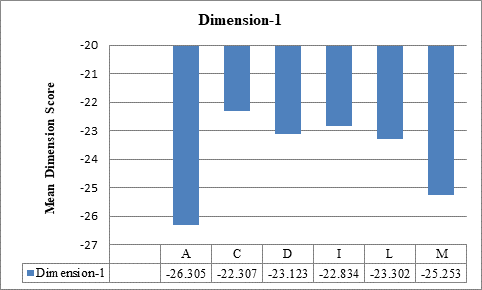
Figure 2
Comparison of Sections of Pakistani Research Articles for Informational features on 1st Dimension

The mean scores of Linguistic features of informational style exhibits multiple relationships among various sections of Pakistani research articles. The Abstract sections are the most informational among all with highest frequency of nouns. Methodology sections are similar to Abstract sections so to speak of the frequency of nouns. The sections of Conclusion have lowest score of nouns frequency as compared with other sections. Prepositions have been found more in Data analysis and Methodology sections. While the least frequency of prepositions have been used in Literature review sections. Attributive adjectives with highest frequency have been found in Abstract sections and then in Conclusion sections. In Methodology sections there have been found the lowest score of attributive adjectives when compared with all sections. The example below highlights the informational stance in methodology section taken from Pakistani research articles corpus.
Example:
“All the results were taken with H.264/SVC reference software JSVM 9.19.10 version encoder. The SE method for H.264/SVC streams was tested at the onset of evaluation by using a set of reference video sequences. For implementation of scheme, the YUV video sequences were downloaded from the URL (ftp.tnt.unihannover.de/pub/svc/test sequences/). A total of 300 frames of the News sequence, 260 frames of the Football sequence and 300 frames of the Mobile sequence were chosen for SE. For ease of testing, the sequence was configured in Common Intermediate Format (CIF) (352 × 288 pixels/frame) @ 25 Hz, with standard 4:2:0 chroma sampling and a variable bit-rate. The frame format was IBBP…., that is a periodic intra-coded frame every 15 frames, with intermediate bi-predicted B-frames and one way predicted P-frames. A BL (layer 0) and four ELs (layers 1–3) were employed”. (CSC.002.4.S)
The above example exhibits a high ratio of attributive adjectives, prepositions and nouns in the methodology section of Pakistani research articles corpus. These informational features highlight the informational stance of Pakistani research articles writers in informing the readers about the methodological details of the research. These features together make the Pakistani research articles highly informational. It highlights the purpose of the research articles as well. The informational stance of Pakistani research articles is in accordance with the underlying objective of research articles that is to inform the reader about the new knowledge. Thus, the density of informational features in Pakistani research articles is related to research articles purpose of enhancing the reader’s knowledge about the new research area.
Variation among Pakistani Research articles sections on Second dimensions
The figure below compares mean values of research sections of Pakistani research articles for dimension-2. This comparison among research sections indicates that Pakistani research articles are highly non-narrative by nature. All sections exhibit degree of variance on this dimension.
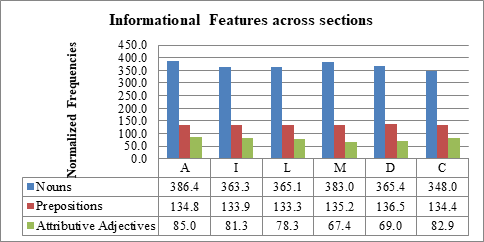
Figure 3
Comparison of Sections of Pakistani Research Articles on 2nd Dimension

The negative mean values exhibit the non-narrative stance of Pakistani research articles. But the comparison also reveals different degrees of non-narrative productions in various research sections. The Introduction sections are the most non-narrative while data analysis and literature review are the least non-narrative among all sections. Conclusion sections share a similar package of non-narrative features with Introduction sections. Abstract and Methodology sections are the next non-narrative sections in securing mean score after conclusion sections. Thus introduction, conclusion, abstract, methodology and data analysis are more descriptive while literature reviews are less non-narrative so inclined toward narrative discourse. This is due to various purposes performed by various sections. As, least non-narrative stance of literature review sections may be due to the focus of the Literature review sections on past and historical references.
The above discussion reveals the descriptive, explanatory and expository nature of Pakistani research articles. It has been observed that in introducing the rationale of the study (Introduction), summarizing the research outcome (Conclusion), providing the reader about the knowledge of research work (Abstract), research procedure (Methodology) and presenting the results (Data analysis) the Pakistani research articles are highly descriptive and explanatory. Whereas, it has also been analyzed that while in reviewing the literature Pakistani research articles have been found least non-narrative. The example below exhibits the non-narrative productions in form of present tense verbs in the conclusion section taken from Pakistani research articles corpus.
Example:
The findings reveal that the letters to the editors are not as uniform as they appear but there are many similarities found among the majority of the sampled corpus, which are termed as their moves. The steps and sub steps found in the letters have some variations too, which shows the variety of the content and ideas presented by writers. It should be noted that our study is of the letters written to editors of only three English newspapers therefore we cannot make generalization concerning the editorial letter genre as a whole. Nevertheless we believe that our study may go some way towards demystifying the writing process of editorial letter written for newspapers and contribute towards the nature and function of the genre in question. At least we now have a baseline against which further research can be carried out in the same genre and the same context. (ENG.001.6.H)
Variation among Pakistani Research Articles Sections on Third Dimension
On third dimension Pakistani research articles sections have been found highly elaborated and explicit. The figure below compares the mean values of research sections of Pakistani research articles for dimension-3. The comparison shows high ratio of explicitness but the degree of elaboration differs in all sections of research articles. As the resulting mean dimension score reveals that Introduction is the most while data analysis is the least explicit. Abstract and conclusion sections have also density of explicit features. Degree of explicitness in Literature review is higher than Methodology and data analysis but lesser than Introduction, Abstract and Conclusion. Closer in explicit features of data analysis are the sections of methodology both share a bit same package of explicit features.
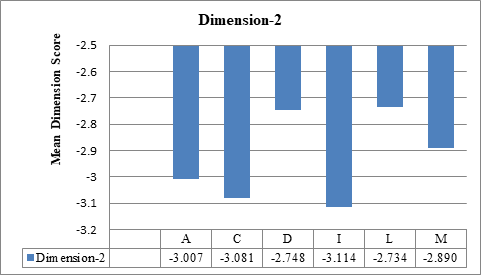
Figure 4
Comparison of Sections of Pakistani Research Articles on 3rd Dimension
 Differences in the degree of explicitness across research sections may be undoubtedly in accordance with the underlying situational purposes and functions of each research section. The Introduction sections are the most explicit as the writer in introduction of the research articles wants to explain and elaborate the new research topic to reader. The purpose to openly and clearly present the rationale of the research is visible in explicit stance of Introduction section. The function underlying Conclusion section is to elaborate the outcome and findings of the research. This is the justification behind the high ratio of explicitness in this particular section. In methodology section the aim is to describe the procedure and method that is why methodology sections mean score is low on explicitness. In addition to methodology the data analysis section highlight the results so are less explicit and elaborated. Further, comparison of explicit linguistic features may be useful to highlight the variations found in various sections of Pakistani research articles. The following figure compares the mean values for explicit linguistic features and their distribution in various sections of Pakistani research articles.
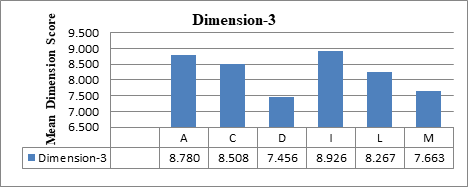
Figure 5
Comparison of Sections of Pakistani Research Articles for Explicit

Features on 3rd Dimension
The comparison of sections along features of explicit stance show interesting relations among Pakistani research articles sections. Nominalizations have been found in highest frequency in abstract sections. Second and third in highest score of Nominalizations are Introduction and Conclusion sections respectively. While, Data analysis sections have the lowest rate of nominalizations among all sections. The comparison reveals that the research sections are dense with maximum usage of nominalizations as explicit stance. Wh relative clauses have been found more in Introduction sections and less in Methodology sections. Coordinating phrases are used in Abstract sections mostly. While in Data analysis there have been found less frequency of coordinating phrases. The example below highlights the explicit production in Introduction section of Pakistani research articles corpus.
Example:
In contemporary situation, institutions either public or private needs the leadership either transactional or transformational who through their competencies (innovativeness and creativity) achieve the task of restoration in these institutions (Avolio & Bass, 2004). The competent leadership can realize the impediments together with the main problems behind. The same phenomenon can be pushed forward to the ultimate objectives with the employees functioning on the front (Avolio, Walumbwa, & Weber, 2009). In the same line, several issues like authority and performance of leadership, communication skills and decision-making, intellectual capabilities and personal characteristics are the core kinematics behind. (BUS.002.2.C) . Nominalizations are important markers of elaboration and explicitness which are highlighted in above paragraph taken from the introduction section of Pakistani research articles corpus. Though a bit variation has been found in the degree of explicitness overall the research sections in Pakistani research articles are elaborated and explicit in nature.
Variation among Pakistani Research Articles Sections on Fourth Dimension
The following graph compares mean values of research sections of Pakistani research articles for dimension-4 and highlights the variation across Pakistani research articles sections. The univariate ANOVA test shows significant statistical differences across research sections of Pakistani research articles along dimension four.
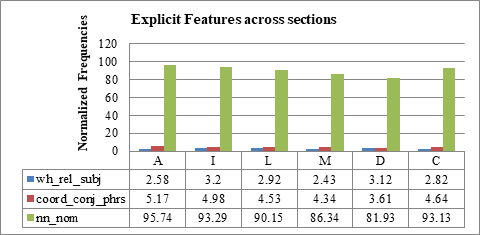
Figure 6
Comparison of Sections of Pakistani Research Articles on 4th Dimension

The comparison of mean values of sections indicates Pakistani research articles as non- persuasive. The sections of Abstract, Conclusion, Methodology and data analysis have been found with high score on this dimension. Thus, these sections are the least persuasive in all. On the other hand Conclusion sections have tendency towards persuasiveness with lowest mean value on this dimension. Introduction and Literature review sections have been found with less degree of non-persuasiveness than data analysis and other sections.
The variations in different sections of Pakistani research articles on this dimension speak of the various underlying purposes performed by these sections. The Conclusion sections give suggestions for further research, convince the reader for the outcome and findings of the research and so are more argumentative and persuasive. Methodology and data analysis sections reveal the exact procedure, methods, tools and results of the research so are less argumentative and persuasive. Abstract sections have been found the least non-persuasive which is in accordance with the objective stance of abstract sections.
Overall Pakistani research articles have been found with the least expressions of persuasions. Persuasive markers for example conditional subordination, suasive verbs and necessity modals are least found in Pakistani research articles. So on dimension four Pakistani research articles have been found less persuasive and less argumentative.
Variation among Pakistani Research Articles Sections on Fifth Dimension
The figure below compares the mean values of Pakistani research articles for dimension-5. The mean dimension scores highlight the impersonal style of different sections in Pakistani research articles. The least impersonal sections among all are that of abstracts. The most impersonal among all are the Conclusion sections. While all other share the similar degree of impersonal features. Conclusion sections have been found with density of impersonal features. Overall Pakistani research articles have been found more abstract, theoretical and conceptual in style.
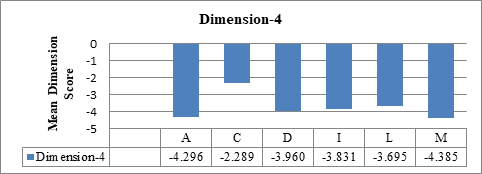
Figure 7
Comparison of Sections of Pakistani Research Articles on 5th Dimension

The following example from Pakistani research articles corpus highlights the impersonal productions in form of conjunctions and passives in conclusion section.
Example:
The silver nanoparticles used in this study were successfully synthesized by using low cost chemical reduction method. The synthesized nanoparticles were in nanometer size as conformed by X-ray diffraction that was 8 nm. The small size synthesized nanoparticles were further studied against bacteria and fungi. The antibacterial activity were studied against different bacteria and found that the small size silver nanoparticles have great effects on bacteria and rapid large interaction with cell to stop their growth. (PHY.001.6.S)
The figure below shows the result of mean values of impersonal features found in Pakistani research articles sections. It reveals the distribution of features like passives and conjunctions among various sections of Pakistani research articles.
Figure 8: Comparison of Sections of Pakistani Research Articles for
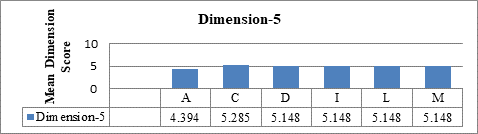
Figure 8
Comparison of Sections of Pakistani Research Articles for

Impersonal Features on 5th Dimension
The comparison of mean scores indicates that passives have been found with highest frequency in Methodology sections. While Introductions sections have lowest mean score of passives. On the other hand Conjunctions are more in Introduction sections while less in Methodology sections. It reveals Introduction sections as most cohesive and Methodology sections as most theoretical in all.
An overview of Comparison of Pakistani Research Articles sections on 1988 Dimensions
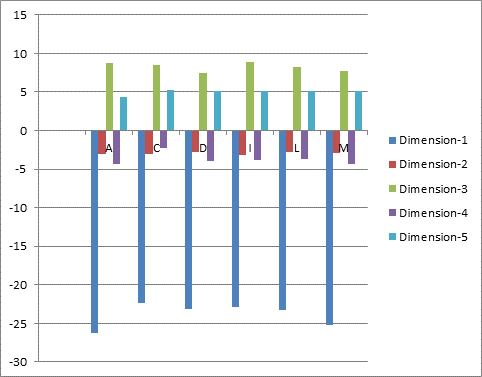
The comparative analysis of linguistic differences in Pakistani research articles sections reveal multiple relationships among research sections on Biber’s 1988 dimensions. The following graph is a visual representation of the comparison of the sections of Pakistani research articles on 1988 textual dimensions.
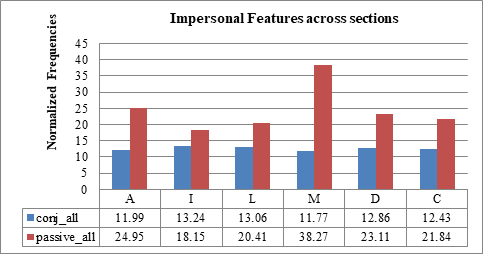
Figure 9
Comparison of Sections of Pakistani Research Articles on 1988 Dimensions

In the first dimension all sections have been found highly informational. But the degree of informational stance is highest in Abstract and Methodology sections. Comparatively higher mean score has been scored by data analysis and literature review sections introduction and conclusion got lowest negative score among all sections on dimension one.
Second dimension mean scores reveal the non-narrative stance of Pakistani research articles sections with minor variations at the level of degree of narration. The most non-narrative in all are the sections of Introduction and conclusion while the least non-narrative are literature review sections. The third dimension mean values comparison indicates Pakistani research articles sections are elaborated and explicit in style. The degree of explicitness varies among all research sections. The least explicit sections are that of Data analysis while the most elaborated among all are Introduction and Abstract sections. Research sections in Pakistani research articles have been found less persuasive and argumentative on fourth dimension. There lies the degree of variation in persuasiveness as well. The most non-persuasive among all are Abstract, Methodology and Data analysis sections while least non-persuasive and a bit inclined towards argumentative discourse are Conclusion sections.
Fifth dimension analysis indicates the research sections of Pakistani research articles as highly impersonal. The most impersonal among all sections are that of Conclusion sections. While, Literature Review, Data analysis and Introduction and methodology share the same package of impersonal stance.
Overall the Abstract sections have been found most informational, most non-persuasive, highly elaborated and least impersonal sections among all. Abstracts are more non-narrative than Literature Review, Methodology and Data analysis and less non-narrative than Introduction and Conclusion. Introduction sections are most elaborated and most non-narrative among all research sections while less informational than abstract, literature review, methodology and result, less non-persuasive than Abstract, Data analysis, Methodology and more non-persuasive than Conclusion, and less impersonal than conclusion. Literature Review sections are highly impersonal, highly informational, least non-narrative among all sections. Literature review sections are less non-persuasive than all and more non-persuasive as compared with Conclusion while more explicit than data analysis and methodology and less explicit than all sections.
Methodology sections are highly informational, highly impersonal and highly non persuasive, less explicit than all, more non-narrative than Literature review and Data analysis. Data analysis sections have been found highly impersonal, highly informational, least explicit, non-persuasive, less non-narrative than all. Conclusion sections are most impersonal, least informational, least non-persuasive, highly non-narrative and among the most explicit sections like Introduction and Abstract. These variations among various research sections are in accordance with the underlying linguistic functions performed by these sections. The density of linguistic features like nouns, conjunctions, passives, nominalizations and present verbs in Pakistani research articles sections highlights highly impersonal, non-narrative, elaborated and explicit, non-persuasive and highly informational stance of Pakistani research articles.
Conclusion
This research paper is an attempt to highlight the nature of Pakistani academic Journal Articles. The research sections in Pakistani academic Journal Articles have been studied to see the linguistic variations. Multifeature/Multidimensional approach has been used to study the data. The analysis reveals the statistical significant differences among different sections of Pakistani academic journal articles. Overall, the analysis reveals Pakistani academic research articles as informational, non-persuasive, explicit, elaborated, impersonal and non-narrative. Abstract sections in Pakistani academic journal articles have been found most informational non-persuasive and highly elaborated. Introduction sections in Pakistani academic journal articles have been found most elaborated and non-narrative among all research sections. Literature Review sections in Pakistani academic journal articles have been found least non-narrative among all sections. Methodology sections in Pakistani academic journal articles have been found least persuasive in all research sections. Data analysis research sections have been found least explicit among all sections. Conclusion sections have been found most impersonal, least informational and least non-persuasive among all research sections in Pakistani academic journal articles. This research paper highlights the distinct nature of Pakistani academic journal articles. It paves the way for future researchers in area of linguistic variation studies in Pakistani context. It highlights the linguistic features of Pakistani academic journal articles. It is worthwhile for academic writers, researchers as well as syllabi designers.
References
- Abdulaziz, M., Mahmood, A. M., Azher. M. (2016). Variation in learner's argumentative essays - A Multidimensional comparative analysis. Science International, 28(4),413-415.
- Aslam, I., & Mehmood, A. (2014). Genre analysis of conclusion sections of Pakistani research articles in natural and social sciences. Journal of Natural Sciences Research, 4 (22), 106-113.
- Azher, M., & Mahmood, A, M. (2016). Exploring Variation across Pakistani Academic Writing: A Multidimensional Analysis. Journal of Critical Inquiry: 14 (II), 86-113.
- Biber, D. (1988). Variation across speech and writing. Cambridge: Cambridge University Press.
- Biber, D., & Finegan, E. (2001). Intra-textual variation within medical research articles. In N. Oostdijk & P. de Haan (Eds.), Corpus-based research into language (pp. 201-222). Amsterdam: Rodopi.
- Biber, D., Johansson, S., Leech, G., Conrad, S., & Finegan, E. (1999). The Longman grammar of spoken and written English. Harlow, England: Pearson Education.
- Conrad, S. (1996). Investigating academic texts with corpus-based techniques: An example from biology. Linguistics and Education, 8, 299-326.
- Egbert, J., (2015)
- Getkham, K. (2010). A Corpus-based Study of Applied Linguistic Research Articles: A multidimensional Analysis. In MoskowichSpiegel Fandino , I., Garcia, B., martin, I., & Sandino, P. (Eds.) Language Windowing through Corpora. Visalizacion del lenguaje a traves de corpus. PartI. Proceedings of CILC 2nd International Conference on Corpus Linguistics, University of A Coruna, Spain.
- Gray, B. (2013).
- Kanoksilapatham, B. (2003). A Corpus-based investigation of Biochemistry Research Articles: Linking Move Analysis with Multi-dimensional Analysis. Unpublished PhD thesis, Georgetown University, Washington, DC.
- Khan, H. I. (2012). The evolution of Pakistani English as a legitimate variety of English. International Journal of Applied Linguistics & English Literature, 1(5), 90-99.
- Mahmood, A. (2009). A Corpus-analysis of Pakistani English (Unpublished doctoral dissertation). Bahauddin Zakariya University, Multan.
- Mahmood, R. (2009). Lexico-Grammatical study of noun phrase in Pakistani English (Unpublished doctoral dissertation). Bahauddin Zakariya University, Multan.
- Moran, K. E. (2013).
- Moore, T. (2002). Knowledge and agency: A study of ‘metaphenomenal discourse' in textbooks from three disciplines. English for Specific Purposes 21: 347- 366.
- Qasim, S., & Shakir, A. (2016). Linguistic Variation of Pakistani Fiction and Non-Fiction Book Blurbs: A Multidimensional Analysis. ELF Annual Research Journal, 18, 185-206.
- Rashid, A., Arif, S., Mahmood, R., Ghayoor, Y. (2014). Format Variation in Business Communication: A Corpus-Based Study of Pakistani Business Letters. International Journal of Management and Organizational Studies, 3(3), 32-44.
- Talaat, M. (1988). A study of lexical variations in Pakistani English: A view on language contact and change. M. Phil thesis, University of Nottingham.
- Salager-Meyer, F. (1992a). A text-type and move analysis study of verb tense and modality distribution in medical English abstracts. English for Specific Purposes. 11(2), 93-113.
- Salager-Meyer, F. (1992b). A genre-based and text-type analysis of hedging in English written medical discourse (1980-1990). Interface, 6(1), 33-54.
- Samraj, B. (2005). An exploration of a genre set: Research article abstracts and introductions in two disciplines. English for Specifc Purposes 24: 141- 156.
- Stoller, F., & Robinson, M. (2013). Chemistry journal articles: An interdisciplinary approach to move analysis with pedagogical aims. English for Specifc Purposes 32: 45-57. DOI: 10.1016/j.esp.2012.09.001
- Swales, J.M. (1990). Genre Analysis: English in Academic and Research Settings. Cambridge: Cambridge University Press.
- Zhen-ye, N. (2008). A genre-based analysis of English research article abstracts and the linguistic feature of personal pronouns for financial economics. US-China Education Review, ISSN1548-6613.
Cite this article
-
APA : Rashid, A., Mahmood, M. A., & Ahmad, S. (2017). Linguistic Variation across Research Sections: A Multidimensional Analysis of Pakistani Academic Journal Articles. Global Language Review, II(I), 15-37. https://doi.org/10.31703/glr.2017(II-I).02
-
CHICAGO : Rashid, Aniqa, Muhammad Asim Mahmood, and Sajid Ahmad. 2017. "Linguistic Variation across Research Sections: A Multidimensional Analysis of Pakistani Academic Journal Articles." Global Language Review, II (I): 15-37 doi: 10.31703/glr.2017(II-I).02
-
HARVARD : RASHID, A., MAHMOOD, M. A. & AHMAD, S. 2017. Linguistic Variation across Research Sections: A Multidimensional Analysis of Pakistani Academic Journal Articles. Global Language Review, II, 15-37.
-
MHRA : Rashid, Aniqa, Muhammad Asim Mahmood, and Sajid Ahmad. 2017. "Linguistic Variation across Research Sections: A Multidimensional Analysis of Pakistani Academic Journal Articles." Global Language Review, II: 15-37
-
MLA : Rashid, Aniqa, Muhammad Asim Mahmood, and Sajid Ahmad. "Linguistic Variation across Research Sections: A Multidimensional Analysis of Pakistani Academic Journal Articles." Global Language Review, II.I (2017): 15-37 Print.
-
OXFORD : Rashid, Aniqa, Mahmood, Muhammad Asim, and Ahmad, Sajid (2017), "Linguistic Variation across Research Sections: A Multidimensional Analysis of Pakistani Academic Journal Articles", Global Language Review, II (I), 15-37
-
TURABIAN : Rashid, Aniqa, Muhammad Asim Mahmood, and Sajid Ahmad. "Linguistic Variation across Research Sections: A Multidimensional Analysis of Pakistani Academic Journal Articles." Global Language Review II, no. I (2017): 15-37. https://doi.org/10.31703/glr.2017(II-I).02