Abstract
Online reviews exert significant influence on the sale and purchase of any product. They not only play a prominent role in the selection of hotels but are also eye openers for the hotel managers because they expose problem areas which need dire attention for the upgradation of quality. Browsing big data from multiple online platforms to find reviews is a time-consuming task. Consequently, Business intelligence is a field which collects and analyses data for customers and managers. This study analyses reviews of 7 hotels in Islamabad through the Social mention tool which gives a visual representation of the strength, sentiment, passion, and reach of each. Multimodal Sentiment Analysis theory has been applied to identify the nature of the reviews. The major findings reveal sentiment analysis of the hotels’ reviews from social media. The research helps individuals in decision making and selection of hotels; and guides the management staff for rectification.
Key Words
Business Intelligence, Social Mention Tool, Hotel Reviews, Sentiment Analysis, Opinion Mining
Introduction
This study is about the sentiment review analysis and opinion mining on the reviews of hotels in Islamabad. The current business situation is understood by business intelligence. In any organization customer needs are understood by business intelligence and also suitable decisions are made with its help. Hidden concepts regarding making any decision have been identified in Business Intelligence. It gathers information from various sources and gives a view of the benign interface. Positive and negative reviews of customers can be identified by opinion mining. It also deals with the influence of those reviews on hotels. With the help of opinion mining, better products have been made and processes improved in order to survive and compete in the market. Opinion mining also plays an important role in decision making on the purchase of products. Restrictions of the products are analysed and then refined products are made using this information. Personal emotions of customers for products are exposed by sentiment analysis. The study in hand has shown the influence of reviews of customers on the rating and management of a specific hotel. The study in hand has taken the reviews of seven hotels in Islamabad and evaluated their ratings with the help of the Social Mention tool. Social reviews about the products can be evaluated with the aid of the Social Mention Tool in a single stream of information. The reviews of customers regarding any product or hotel are analysed by the Social Mention tool. The study has used the Multimodal Sentiment Analysis theory. Multimodal Sentiment Analysis theory detects and analyses emotions and expressions of reviews.
Problem Statement
There are works done on the review analysis and the impact of that analysis on the purchase and sale of products, but in the hotels of Islamabad, this work is missing. One cannot read all the reviews of all the hotels. Previous reviews are significant for the selection of any product and for management in improving the quality of that product.
Significance of the Study
The study has the following significant aspects: The first aspect is to evaluate how the rating of any hotel will help tourists to make decisions in making the choice of hotel. Managers will be able to make improvements in their services to customers by comparing the rating of their hotel with other competitors. Previous reviews of any hotel will help tourists in making or changing their decision of booking the hotel.
Research Objectives
The current approach will fulfil the following objectives
i. To help the customers to get an overview of the quality of hotels without reading all the reviews.
ii. To check the strength of the population talking about any particular product.
iii. To check the sentiment, the ratio of negative to positive ratio.
iv. To check the passion of the public about the product.
v. To check the reach, which is a measure of the range of influence.
Research Question
The current study addresses the following research question:
i. How does Social Mention Tool reveal sentiment analysis of hotel reviews from various social media websites?
Literature Review
Chung and Tseng (2012) suggested that for the production of new products, online product reviews were of great importance in Business intelligence. Companies which provided online product review services proved to be highly significant and created a great impact on their reputation of the company. Tools make it easy for the managers to evaluate the real feelings of the customers about the product. Ratings of the product can be evaluated by companies or managers through online reviews. The relationship between the reviews of the customers and ratings of users could be examined by the managers through the analysis of reviews. Qualitative and quantitative experiments could be conducted by Business Intelligence founded on rough set theory. The use of tools helped to get clear-cut, fixed, consistent and effective results. The outcomes were of great value for controlling the administration and running the company. The companies which were deficient in the analyses of online comments were not able to get significant profit from the reviews of the customers.
Sharad, Ashok and Dattatray (2018) proposed that on social media, many people give their reviews and opinions. For the promotion of goods, the data present on social media was always of great significance. Examiners directed assessment of opinions that was an unconscious procedure because all the opinions could not be read by customers. The text and reviews were allowed into various sections by researchers for example, joyful, annoyed, abhorrence, fondness etc. All the mistakes were removed by pre-processing technique. Accurate results were given by NLP procedures and there were benign effects for the users of products and supervisors of the companies. The more genuine and realistic data led to more precision in outcomes.
Kasper and Vela (2012) described that the reservation of hotels and scheduling for the tourism reviews and commentaries played a great role. To improve the excellence of hotel review, inquiry was extremely important. The technique of mining opinions of virtual reviews was used by researchers to get information easily. Hotels were being rated by the clients from 1 to 5. This score was not advantageous for the hotel administrator as the numeric value did not provide evidence of the purchaser's genuine apprehension. These values did not discriminate between the ratings of the hotel on the other side while word-based analyses could be advantageous for managers. They discriminate among three dissimilar sections of opinions which can be optimistic reviews, adverse reviews and impersonal. The impersonal segment didn't give any assessment of the reviews. The quality of the hotel was controlled by a tool named BESAHOT. With the aid of this tool, a general idea about what the people have stated or commented about their hotel on social media can be gained.
Most of the time, it was difficult to analyse the reviews because of the way people expressed them. Text mining and exploration of amorphous data were difficult to be analysed which made it difficult to label information automatically. In this research paper, they examined the reactions of customers to hotels which were related to their sentimentality about the worth of hotels. Passions, assertiveness, and behaviours were described through figurative language which is why it was challenging to assess the dataset of sentiments. The impartial spontaneous examination of thoughts and feelings was given by the outline of sentiment polarization which was suggested by researchers. An appropriate machine learning procedure was revealed by relative exploration for the arrangement of constituents of structure (Zvarevashe & Olugbara, 2018).
Shi and Li (2011) stated that the products which were widespread and had a great number of comments. E-commerce has turned out to be a part of the public's life for the reason that people make too much use of social media. The excessive comments on the internet make it difficult for the customers to take a stance on buying a product and it also becomes tuff for the supervisor of the company to manage the reviews of customers. The polarization of online reviews was comprehended by researchers with the assistance of an approach of supervised machine learning. In this way, they worked on the reviews of hotels. Two types of data were compared and contrasted with each other, which were the frequency and TF-IDF. The second data was more precise than the data related to frequency.
It was explored by the study that purchaser response was necessary to be taken by the hotel industry. That response was highly persuasive, powerful and benign to expanding the facilities. The hotel industry had to undergo many procedures to complete their aim of getting accurate responses from the clients. In this research paper, they have explored and analysed the 57 hotels in Moscow and their reviews were 5,830. There was more destructive criticism than constructive criticism. Positive comments had a lesser impact on the public as compared to negative comments. More variations were depicted by adverse reviews as compared to favourable reviews. The administration of hotels was refined by these significant things (Mankad, Han, Goh, & Gavirneni, 2016).
Research Methodology
Theoretical Framework
The study in hand used the Multimodal Sentiment Analysis (MSA) theory. Sentiment Analysis corresponds to a process where any idea, whether written or oral, is understood; in other words, it is called Natural Language Processing (NLP). Three kinds of modality that is, deontic, epidemic and dynamic are there in English. The first type is associated with letting people do and acquire things such as consent and compulsion. The finding, inference, and comprehension of the reality of a proposition are conveyed through the second type of modality, that is, the epidemic modality. Aptitude, free will, freedom, or preference is conveyed by the third type of modality. Auditory and pictorial information, as well as text, is included in this theory. The text and sequence of words are assessed when word-based structures are analysed. Phonetic and prosodic features are analysed in aural features which exert an influence on the feelings of the public. The pictures and facial expressions are considered graphic features as they are essential in the analysis of sentiments. Deceitful images as well as the reputation and status of image tweets can be recognized through visual features (Liu, 2015, p. 123).
Research Design
The study was based on a quantitative based study review analysis of hotels.
Data Generation Tools
Social Mention tool was used to analyse hotel reviews. Mention organization made Social Mention Tool in April 2012 in Paris, France. Mention is a company that observes media. Information could be shared by this tool on the internet and also reviews of people about the organizations and their products could be checked. More than 80 online networking sites such as Google search, Facebook pages, Friend Feed, Twitter, YouTube, Google, Instagram, Google search and so on are being analysed by this tool. Forty-two different languages can be searched with the assistance of this tool. A free version is allowed to people by this tool like many other tools.
Social Mention Tool

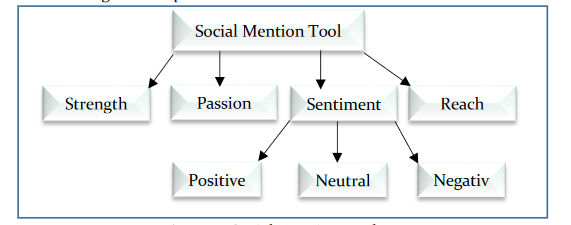
Social Mention Tool shows the analysis of the strength, passion, reach and sentiments of the people about the specific product. Sentiments can be positive, neutral and negative. This can be measured with the help of the Social Mention tool.
Data Analysis Method
This study is being conducted in the city of Islamabad. This research is about the review analysis of seven hotels in Islamabad. These hotels include
i. Serena Hotel.
ii. PC Hotel.
iii. Shalimar Hotel Islamabad.
iv. Islamabad Marriott Hotel.
v. Islamabad Margala Hotel.
vi. Rose Palace Hotel.
vii. Islamabad Inn.
This study used Social Mention Tool. Data is being collected with the help of the Social Mention tool. This tool analysed the score for excellence, estimation, eagerness and variety.
In this research paper, MSA theory is used also identified as Natural Language Processing (NLP). Characteristics of expressions as well as opinion identification are also extracted through these systems. For example
i. Polarity: it describes opinions whether they are positive or negative.
ii. Subject: a specific trait of the merchandise being discussed by people.
iii. Opinion holder: it refers to a person who gives his opinion.
The unorganized data could be automatically changed into structured information with the help of sentiment analysis (Liu, 2015).
Results
The current approach showed that the majority of the customers gave positive reviews. Sentiment analysis was the ratio of negative reviews to the ratio of positive reviews. The major comparison was between the positive and negative reviews of the customers. People tend to give positive reviews more than negative ones. This was the evaluation of the emotions of people related to the services of hotels. The results were being conducted with the help of the Social Mention Tool and the Multimodal Sentiment Analysis theory was applied. Social Mention Tool covered all the positive, neutral and negative reviews from all the social media sites. The neutral reviews were absolutely clear and expressive and did not need any analysis. In this study for sentiment analysis, only positive and negative reviews were evaluated with the help of the Social Mention tool.
Table 1. Percentage of Strength, Passion, Reach and Sentiment with Social Mention Tool
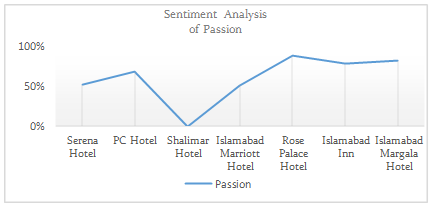
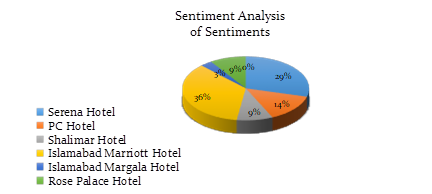
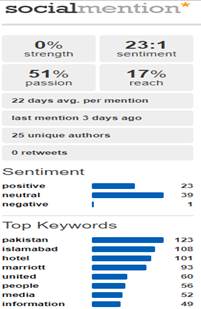
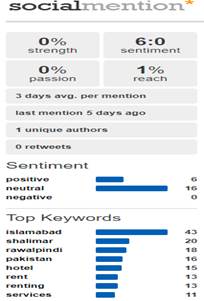
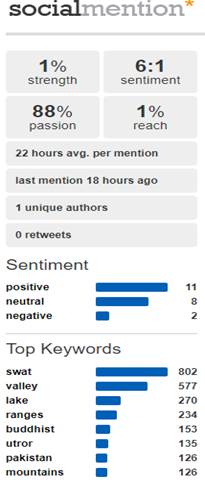
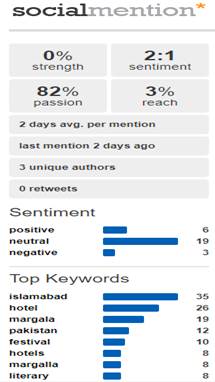
| Names of Hotels of Islamabad width="72">Strength width="66">Passion width="59">Reach width="132">Sentiment Positive: Negative | > Serena Hotel width="72">0% width="66">52% width="59">17% width="132">19:1 | > PC Hotel width="72">0% width="66">68% width="59">8% width="132">9:1 | > Shalimar Hotel width="72">0% width="66">0% width="59">1% width="132">6:0 | > Islamabad Marriott Hotel width="72">0% width="66">51% width="59">17% width="132">23:1 | > Islamabad Margala Hotel width="72">0% width="66">82% width="59">3% width="132">2:1 | > Rose Palace Hotel width="72">1% width="66">88% width="59">1% width="132">6:1 | > Islamabad Inn width="72">0% width="66">78% width="59">8% width="132">24:1 |
Analysis of Sentiments of the Hotels of Islamabad

Sentiment Analysis of Passion

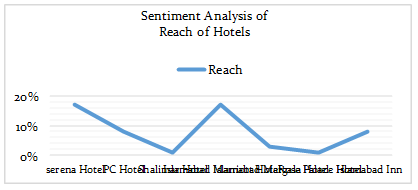
Sentiment Analysis of Reach of the hotels in Islamabad

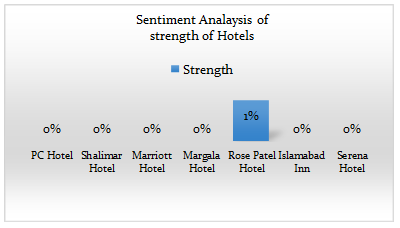
Sentiment Analysis of the Strength of Hotels

Discussion
Online reviews have a great impact on the sale and purchase of a product. A lot of work is done on opinion mining and review analysis, but in the hotels of Islamabad, this work of review analysis is missing. One cannot read and analysed all the reviews from all the social media sites. Previous reviews are significant for the sale and purchase of the product. With the help of online reviews, managers can evaluate the relationship between the customers’ reviews and users’ ratings. They can evaluate the market demand of their hotel and can compare it with their opponent’s success. Online reviews provide us with information about the customer’s needs and demands. Opinion mining and sentiment review analysis can give us information about the positive and negative reviews of the hotel. People on social media express their opinions in a very complex manner which is difficult to analyse. But these reviews are significant for improving the quality of hotels. Kasper and Vela (2012) stated that people usually rate the hotel from 1 to 5 which is not enough because the numeric value does not rate the reviews into positive and negative ones. Customers' concerns cannot be analysed through numerical values. Reviews are being analysed in different segments which are positive, negative and neutral. Negative reviews make damage the image of the hotel and also give a chance to the management to make improvements in their services. Mostly, the comparison is between positive and negative reviews and neutral reviews are being ignored. This is a very challenging task for the hotel to analyse accurate reviews from the customers. With the help of the social mention tool, we can evaluate the quality of the hotels without reading all the comments. This gives us a clear percentage of the reviews which shows the sentiment, reach, strength and passion of the particular hotel. Strength is the number of people talking about a particular product. Reach signifies the range of influence of a product on the customers. The passion of the customers for the product can also be checked through the Social Mention tool. Social Mention Tool reveals sentiment analysis of hotel reviews through social media websites. The collection of information in real time data is a difficult task. With Social Mention Tool and Multimodal Sentiment Analysis theory, we can get real-time data and can evaluate the real passion and emotions of customers. Multimodal Sentiment Analysis theory expresses the possibility and the real meaning of the reviews which are subjective in nature. Through Sentiment Analysis Theory, we can evaluate the nature of the reviews of customers which can be concerned with free will, permission or judgment or any other concern. The fake visual images on social media sites can also be identified through Sentiment Analysis Theory.
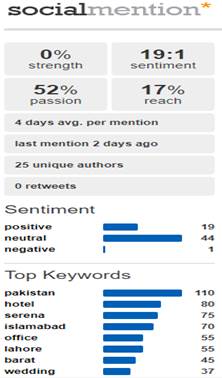
This research has taken calculations of seven hotels in Islamabad through Social Mention Tool. First, for Serena Hotel, Social Mention Tool shows the result from all the social media sites on which Serena Hotel is being discussed. It shows the strength, sentiment, passion, reach, top key words and hashtags related to the specific hotel.
Serena Hotel Islamabad

PC Hotel Islamabad

Shalimar Hotel Islamabad

Islamabad Marriott Hotel

Islamabad Margala Hotel

Rose Palace Hotel

: Islamabad Inn Hotel

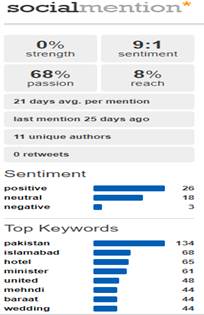
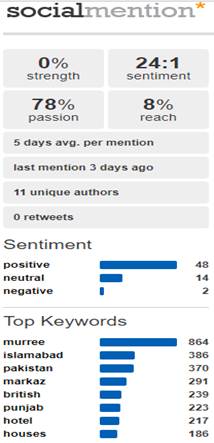
The last one is the Islamabad Inn hotel. The strength calculated by Social Mention Tool for this hotel is 0%. The last mention of this hotel is 3 days before. The ratio of sentiment is 24:1 and the ratio of neutral reviews is 14 which shows people give positive reviews more than negative ones. The reach of people for this hotel is 8% because this hotel has 11 unique reviewers talking about the hotel. Passion for Islamabad Inn Hotel is 78%. The top keywords are Murree, Islamabad, Pakistan and Markaz etc. The picture below shows the evaluation of reviews taken from the Social Mention tool for the Islamabad Inn Hotel.
For customers, it is a big hurdle to read all the reviews of all the hotels. To read and analyse all the reviews is a time-consuming task. For one individual it is impossible to analyse all the reviews from all social media sites. This study shows how the Social Mention tool helps the customers to make their decisions for choosing a hotel. This tool helps the managers to make improvements to fulfil the demands and desires of the customers.
Conclusion
In this research work, the method to analyse all the reviews by the Social Mention tool is being proposed. This study in hand described that previous reviews are important for the decision making and reviews help the managers to improve their services. Through the social mention tool, this study found that customers can get an overview of the quality of the hotel without reading and analysing all the reviews. The current study evaluated the strength, passion, sentiment and reach of the people towards the particular hotel. A number of key issues related to online review analysis are being discussed in this study. First, this study analysed the real-time data of the 7 hotels in Islamabad. Second, this research work has told how Social Mention tool is effective in analysing online reviews. Third, it analysed the passion, reach sentiment and strength of the online reviews of the hotels in Islamabad. This approach has a number of advantages. First, it has made it easier for customers in making decisions about booking hotels and saves their time. Second, this study has helped managers to improve their services and can compare their services with other competitors.








References
- Chung, W., & Tseng, T. (2012). Discovering business intelligence from online product reviews: A rule-induction framework. Expert Systems with Applications, 39(15), 11870-11879.
- Kasper, W., & Vela, M. (2012). Monitoring and Summarization of Hotel Reviews. Information and Communication Technologies in Tourism 2012, 471-482.
- Kaur, R., & Kautish, S. (2019). Multimodal Sentiment Analysis. International Journal of Service Science, Management, Engineering, and Technology, 10(2), 38- 58.
- Liu, B. (2015). Opinions, Sentiment, and Emotion in Text. Cambridge, England: Cambridge University Press.
- Mankad, S., Han, H., Goh, J., & Gavirneni, S. (2016). Understanding Online Hotel Reviews Through Automated Text Analysis. Service Science, 8(2), 124-138.
- Ullah, M. A. (2017). An overview of Multimodal Sentiment Analysis research: Opportunities and Difficulties.
- Sharad, D. A., Ashok, D. S., & Dattatray, D. P. (2018). Sentiment Analysis of Hotel Review. IJARCCE, 7(11), 174-176.
- Shi, H., & Li, X. (2011). A sentiment analysis model for hotel reviews based on supervised learning. 2011 International Conference on Machine Learning and Cybernetics.
- Zvarevashe, K., & Olugbara, O. O. (2018). A framework for sentiment analysis with opinion mining of hotel reviews. 2018 Conference on Information Communications Technology and Society (ICTAS).
Cite this article
-
APA : Ullah, Z., Uzair, M., & Tahir, A. (2022). Opinion Mining of Online Reviews about Certain Islamabad Hotels: A Business Intelligence Study. Global Language Review, VII(II), 148 - 160. https://doi.org/10.31703/glr.2022(VII-II).13
-
CHICAGO : Ullah, Zafar, Muhammad Uzair, and Aiman Tahir. 2022. "Opinion Mining of Online Reviews about Certain Islamabad Hotels: A Business Intelligence Study." Global Language Review, VII (II): 148 - 160 doi: 10.31703/glr.2022(VII-II).13
-
HARVARD : ULLAH, Z., UZAIR, M. & TAHIR, A. 2022. Opinion Mining of Online Reviews about Certain Islamabad Hotels: A Business Intelligence Study. Global Language Review, VII, 148 - 160.
-
MHRA : Ullah, Zafar, Muhammad Uzair, and Aiman Tahir. 2022. "Opinion Mining of Online Reviews about Certain Islamabad Hotels: A Business Intelligence Study." Global Language Review, VII: 148 - 160
-
MLA : Ullah, Zafar, Muhammad Uzair, and Aiman Tahir. "Opinion Mining of Online Reviews about Certain Islamabad Hotels: A Business Intelligence Study." Global Language Review, VII.II (2022): 148 - 160 Print.
-
OXFORD : Ullah, Zafar, Uzair, Muhammad, and Tahir, Aiman (2022), "Opinion Mining of Online Reviews about Certain Islamabad Hotels: A Business Intelligence Study", Global Language Review, VII (II), 148 - 160
-
TURABIAN : Ullah, Zafar, Muhammad Uzair, and Aiman Tahir. "Opinion Mining of Online Reviews about Certain Islamabad Hotels: A Business Intelligence Study." Global Language Review VII, no. II (2022): 148 - 160. https://doi.org/10.31703/glr.2022(VII-II).13