01 Pages : 1-16
Abstract
The present study highlights lexical variation in Dhani and Majhi dialects of Punjabi language spoken in Pakistani Punjab that may lead to a communication gap. It focuses on the description of vocabulary differences of words of daily use. It is partly qualitative and partly quantitative research, which was conducted through a survey. Data were collected from thirty participants (15 speakers from each variety) from Chakwal district of Rawalpindi Division and Sheikhupura, Nankana Sahib districts of Lahore Division in Punjab province, Pakistan. It was collected through a word list consisting of two hundred and sixty vocabulary items that are used in daily conversation. Results retrieved from analysis of the collected data show that two hundred and nine Dhani words, i-e 80 %, do not exist in Majhi variety at all and have their alternatives in Majhi whereas, fifty-one words i-e 20 % exist but are pronounced differently in Majhi.
Key Words
Dhani, Dialect, Lexical Variation, Majhi
Introduction
Background to the Study
Language variation is present in all languages of the world (Shareah, Mudhsh, & AL-Takhayinh, 2015). It is not a defect of a language and does not make any language less in rank or quality in comparison with other languages. Every language has different dialects or varieties. A dialect is a set of linguistic items with similar distribution (Hudson, 1996). Crystal (2008) defines it as a regionally or socially distinct variety of language that has its particular set of words and grammatical structure. It is different from the accent that is a distinctive way of pronouncing a language. A dialect is a variety that is characterized by phonological, lexical, and syntactic properties (O’Grady, Archibald, Aronoff, & Rees-Miller, 2001).
Pakistan is linguistically a rich country where six major languages, including Urdu, English, Punjabi, Sindhi, Pashto, and Balochi, and fifty-nine minor languages are spoken (Rahman, 2006). Simons and Fennig (2017) describe seventy-three languages in the Ethnologue: Languages of the World that are spoken in Pakistan. Punjabi is spoken by 38.78% of the total population ("Population Census," 2017).
Lexical differences in everyday language lead to communication gaps or failure of communication. This research intends to analyze and describe lexical differences of Dhani (earlier written as Dhanni) and Majhi dialects of the Punjabi language in the Punjab province of Pakistan. Dhani is spoken in parts of Rawalpindi Division (Pothohar Plateau), Chakwal, and southern parts of Jhelum and Attock districts, whereas Majhi is spoken in Gujranwala, Sheikhupura, Lahore, Sahiwal, and areas of Multan Division. It is the prestige variety and is the standard of written Punjabi.
Statement of the Problem
The vocabulary of Dhani is different from that of Majhi. This study is about lexical differences of Dhani and Majhi dialects of Punjabi language with reference to a few selected words of daily use, which usually pose difficulty in understanding a message or create a communication gap to the speakers of both varieties. It also intends to document the said lexical items of Dhani, which mainly exist in oral form only.
Aims and Objectives
The objectives of the research are:
1) To identify entirely different lexemes in Dhani and Majhi
2) To find similar lexemes with variation in both dialects
Research Questions
The research answers the following questions based on the objectives of the study:
1) Which lexemes are completely different in the Dhani and Majhi dialects of Punjabi?
2) Which lexemes exist in both dialects but vary in meanings or pronunciation?
Significance of the Study
The present study is significant in knowing the lexical differences of two dialects of Punjabi as it gives an accurate description of these differences with the help of examples through first-hand data. It also highlights to what extent both varieties can be similar or different from each other. Dhani is one of the undescribed varieties of Punjabi (Waseem, 2017). This research can be beneficial for future researchers to describe some aspects of this variety. It may be helpful to develop educational material and written literature for language learning and teaching to promote this variety and may urge to explore indigenous languages of Pakistan.
Limitation of the Study
The research is limited to exploring lexical differences of both varieties and is delimited to a few selected words of daily use. Other properties of dialect variations i-e pronunciation and syntax, are not described.
Literature Review
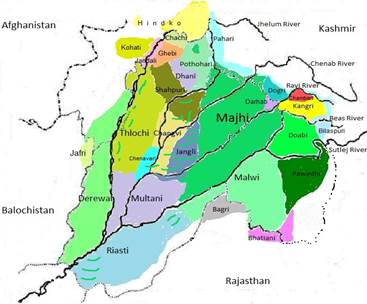
Punjabi is spoken as the mother tongue by a large number of people in Pakistan ("Population Census," 2017). It has twenty major and minor dialects. Majhi, Doabi, Malwai, Powadhi, Pothohari, and Multani are the major dialects of Punjabi (Tariq, 2012). Minor dialects include Shahpuri, Jhangochi, Jangli, Hindko, Dhani, Jandali, and Chachi, etc. Figure 1 below by Mahmood (2010) shows the dialects of the Punjabi language spoken in Pakistan:
Figure 1
Dialects of Punjabi spoken in Pakistan

Dhani derived its name from ‘Dhan Valley’, which is situated 35 km away from Rawalpindi. Majhi derived its name from the Majha district of Indian Punjab, where it is spoken as a standard variety. The two main cities of this region are Lahore (Pakistan) and Amritsar (India). People of Lahore call their Punjabi Lahori Punjabi rather than Majhi.
Dhani was classified by Grierson (1917) as a dialect of Punjabi into the Northern cluster of Lahnda. He used the word Lahnda in his Linguistic Survey of India (LSI) to identify a group of varieties (dialects) spoken in Western Punjab. These varieties include Pothohari, Jhangochi, Shahapuri, Dhani, Malwai, Dogri, Sariki or Multani, Doabi, Hindko, and Pwadhi. Majhi dialect is a binding force to other dialects of Punjabi.
Dialectology, a subfield of sociolinguistics, refers to the study of dialects scientifically (Petyt, 1980). Its focus is variation in a language that is based on geographic distribution. Dialect variation is very natural to the languages of the world. Shareah et al. (2015) discuss the example of the English language that has many varieties, which include Australian, British, American, Nigerian, and South African English, etc. British English is very different from American English. Sanyal (2013), in his comparative study of British and American English, identifies lexical variation between two varieties. A similar survey study has been done by Di Carlo (2013) to analyze reciprocal comprehension between these two varieties. Both these studies conclude that besides differences, British English has many terms adopted from American English and vice versa. It is because of TV programs, the Hollywood industry, and information and communication technology.
Deáková (2013) discusses the classification of vocabulary made by Strevens (1972) as common word stock, common ideas, different words, and words with no counterparts. She also discusses lexical differences marked by Trudgill and Hannah (2002). These differences include the same words with different meanings, the same words with additional meanings in one variety, same words with the difference in frequency of use, connotation, and style.
Jamshaid (2016) surveyed five Punjabi dialects (Majhi, Doabi, Saraiki, Pothohari and Jangli) to see how far lexical variation marks regional boundaries. The research concludes that lexical variation occurs among these dialects, and it differentiates the resident of one area from that of another. It also highlights that lexical variation and these differences can mark the existence of regional boundaries. Hasan and Khan (2019) explored English loanwords in Dhani. It discusses the phonological variation of these words. These researches are significant because these urged authors of the present study to describe lexical differences in Dhani and Majhi dialects of Punjabi in day-to-day language usage that can lead to communication gaps or can pose confusion in communication in certain cases.
Methodology
This is descriptive research in design, and it follows a mixed method approach. Based on the survey, it intends to describe variation in lexical items of Dhani and Majhi varieties of Punjabi language. The focus of the study is to highlight the vocabulary differences of these dialects as they appear in daily use. The native speakers of Dhani from the Chakwal district of Rawalpindi Division and Majhi speakers of Sheikhupura and Nankana Sahib Districts of Lahore Division were the population of the research. A sample of 30 native speakers of Dhani and Majhi (15 speakers from each variety) belonging to different social, regional and educational backgrounds was selected from the population. The sample was selected through the purposive sampling technique. The sample included males and females of different age groups who had a rich knowledge of their language and culture. Elderly people above 50 years of age were given preference in the selection of sample because a new generation of these varieties is moving to other cities for education or job purposes, and their language is getting mixed with other varieties. The detailed division and selection of informants are as described in Table 1 below:
>Table 1. Division of Participants in Groups align="center">
| S. No width="76" valign="top">Informants width="78" valign="top">Dialect width="134" valign="top">Regional Background width="111" valign="top">Tehsil width="92" valign="top">District | > 1 width="76" valign="top">5 width="78" valign="top">Dhani width="134" valign="top">Bhalla width="111" valign="top">Chakwal width="92" valign="top">Chakwal | > 2 width="76" valign="top">5 width="78" valign="top">Dhani width="134" valign="top">Kallar Kahar width="111" valign="top">Kallar Kahar width="92" valign="top">Chakwal | > 3 width="76" valign="top">5 width="78" valign="top">Dhani width="134" valign="top">Kotli Saidan width="111" valign="top">Choa Saiden Shah width="92" valign="top">Chakwal | > 4 width="76" valign="top">5 width="78" valign="top">Majhi width="134" valign="top">Narang width="111" valign="top">Muridke width="92" valign="top">Sheikhupura | > 5 width="76" valign="top">5 width="78" valign="top">Majhi width="134" valign="top">Sharaqpur width="111" valign="top">Sharaqpur width="92" valign="top">Sheikhupura | > 6 width="76" valign="top">5 width="78" valign="top">Majhi width="134" valign="top">Panwan width="111" valign="top">Shah Kot width="92" valign="top">Nankana Sahib |
Data was collected in written form through a vocabulary list. Elicitation was also used as a backup to record responses of the informants because recorded data allows for playback that facilitates data analysis. Researchers belong to Majhi speaking community, and Dhani is not their mother tongue; therefore, two bilingual and educated native speakers (from Chakwal) were hired as research assistants (RAs) for communication, facilitation and acceptability of data during the data collection process. One of the RAs was from village Bhalla of tehsil Chakwal. He is a physician (Hakeem) by profession and has a vast knowledge of his language and areas where Dhani is spoken as his mother tongue. Second RA was from village Pinwal of tehsil Chakwal. He is a university student. He is doing Masters in English language and teaches in a private institute in the evening. Both of them accompanied the researchers for data collection from all the three tehsils (Chakwal, Kallar Kahar, Choa Saiden Shah) of Chakwal District, Punjab, Pakistan.
A wordlist consisting of 210 items of basic and standardized vocabulary i-e names of birds, animals, colors, days of the week, names of months, seasons, parts of the body, relations, names of meals, fruits, vegetables, crops, etc., formed by Mathai (2011) and Hallberg et al. (1992) was selected and adapted with the help of RAs to get responses from all the participants of both dialects to draw a comparison. Wordlist in printed form was given to each participant and was explained. Each informant was asked to read and fill the list with words from their language variety against each category. The purpose of wordlist comparison was to determine the extent to which the vocabulary of each speech form is different.
Data Analysis
The collected data through elicitation was grouped into relevant lexical categories (word classes). The detail of these categories in percentage has been shown in Table 2 below:
Table 2. Detail of Word classes
| S. No width="188">Word Classes width="134">Frequency width="160">Percentage | > 1 width="188">Nouns width="134">182 width="160">72% | > 2 width="188">Pronouns width="134">12 width="160">5% | > 3 width="188">Verbs width="134">30 width="160">11% | > 4 width="188">Adjectives width="134">32 width="160">12% | > 5 width="188">Adverbs width="134">4 width="160">2% | > width="188"> Total width="134">260 width="160">100 |
Figure 2
Percentage of Word classes

Data was transcribed into Indological IPA transcription according to ISO-15919: 2001, and the analysis was done through comparison by presenting data into tables. Every table contains three columns. The first column shows Dhani response, the second column presents Majhi response, and the third column contains gloss (basic vocabulary in the wordlist). Description of the data has been given by dividing it into different word classes as below:> > >Nouns>Nouns are the first building blocks of a language. They are the essential category in comparison with other parts of speech and form a long list in any language. The present study discusses the following categories of nouns of both varieties of Punjabi:> >House vocabulary>Vocabulary items related to the house in general, which is different in both dialects, have been shown in Table 3 below:
>Table 3. House Vocabulary align="center">
| Dhani width="190">Majhi width="190">Gloss | > ghar width="190">ka?rh width="190">House | > pa? width="190">šat?r, šat?ri width="190">Beam (wooden) | > pa? width="190">g??ar width="190">Girder | > kadh width="190">kandh width="190">Wall | > b?hr? width="190">bokar width="190">Broom | > pas?r width="190">br?n?? width="190">Veranda | > chanch?mb? width="190">la?r?n, c??r? width="190">Toilet |
Dhani word pa? used for beam and girder exists in Majhi also. Its pronunciation is also the same, but it is used for a plank of the door in Majhi. Similarly, Majhi word bokar ‘broom’, is also used in Dhani for the same thing.>Parts of Body>Nouns related to body parts also show variation and have been given in Table 4 below:
>Table 4. Parts of Body align="center">
| Dhani width="192">Majhi width="192">Gloss | > dhau? width="192">tau? width="192">Neck | > v?t width="192">m??h width="192">Mouth | > bharva?e width="192">parva?e width="192">Eye brows | > ha?yo?/ h??o? width="192">d??h width="192">Jaw tooth | > ?ruk width="192">koh?i width="192">Elbow | > juss? width="192">pin?? width="192">Body | > piplo? width="192">palk?? width="192">Eyelashes |
Dhani word juss? ‘body’ exists in Majhi also and is used to describe the inner state or temperament of a person rather than a body part. Its pronunciation is the same as it is in Dhani.> >Kitchen Items>Kitchen items include utensils and other cooking-related things that are common in both cultures. These lexemes have been presented in Table 5 below:
Table 5. Kitchen Items align="center">
| Dhani width="177">Majhi width="178">Gloss | > raso?, ku?hey?l? width="177">barch? kh?n? width="178">Kitchen | > s??k? width="177">th?l? width="178">Plate | > tr?m? (metal) width="177">pr?t width="178">Skillet | > ka?v? width="177">h?n?? width="178">Pot | > lau? width="177">s?la? width="178">Curry | > g?r?? width="177">burk? width="178">Bite | > b?n?? width="177">p??hi width="178">A small stool | > ?a?? width="177">?akkan width="178">Lid | > k?suk width="177">camci width="178">Spoon | > ?hakun width="177">chapa? width="178">Lid of cooking pot (clay) | > jhau?? width="177">cap?? width="178">Lid of pitcher | > s??ak width="177">ka???? width="178">Platter (clay) | > gheo width="177">keo, kai width="178">Ghee | > ghugh?i?? width="177">kungri?? width="178">Marende (a dish) | > s?bu? width="177">s?ba? width="178">Soap | > manjr?l width="177">k?c? width="178">Dish cloth | > kop, ?ull? width="177">magg? width="178">Cup | > j?? width="177">bat? width="178">Lamp cotton wicks | > tarak?? width="177">t?ak?? width="178">Scale | > g?c?, poc? width="177">g?c?? width="178">Clay | > jole, jarole width="177">se?vi?? width="178">Vermicelli | > l?ngr? gho?n? width="177">k?n?? ?an?? width="178">Mortar (stone/clay) | > l?ngr? gho?n? width="177">ca?h? va?? width="178">Mortar (iron) | > chakor width="177">ch?b?, ch?b? width="178">Basket for loaves | > daj? width="177">po??? width="178">Cloth for loaves |
Dhani word raso?, which means kitchen in English, is also used by Majhi speakers in some areas, especially where migrants settled from India after the Pakistan-India partition in 1947. It is used with the same meanings and pronunciation in both varieties. Dhani word lau? is also used in Majhi but differently. It is used mostly in villages for a dish made of Split Chickpeas and Sweet Gourd or Tinda (Apple gourd). Similarly, the Dhani word poc? ‘clay’ also exists in Majhi and is used differently. Majhi speakers use this word for plaster of mud on walls or floors of houses in remote villages. This mud plaster is not very common these days, and this term is used for mopping the floor in both cities and villages.> >Food Items>Food items include names of dishes, fruit and vegetables. Table 6 below shows a few food items that vary in both varieties:
>Table 6. Food Items align="center">
| Dhani width="172">Majhi width="172">Gloss | > n?kh width="172">n?šp?ti/ n?k width="172">Pear | > vid?m width="172">bad?m width="172">Almond | > m?kheyo? width="172">šaid width="172">Honey | > pro?h? width="172">pro?h? width="172">Paratha | > phulk?/ t?p width="172">ro?? width="172">Loaf | > khum width="172">khumb? width="172">Mushroom | > khakh?? width="172">kharb?z? width="172">Melon | > gair width="172">g?jar width="172">Carrot | > vit??? width="172">bat??? width="172">Eggplant | > ?hipar width="172">go?gl? width="172">Turnip | > bair width="172">beir width="172">Plum | > muphall? width="172">m??gphal? width="172">Peanut | > maruc width="172">mirc width="172">Pepper, chili | > hardul width="172">hald? width="172">Turmeric | > hadv??? width="172">dhav??? width="172">Water melon |
Dhani word pro?h? ‘Paratha’ is also used by Majhi speakers for the same. The only difference identified is of the size of the thing. If it is big in size, they call it pro?h? ‘Paratha’ and if it is small, they call it pro?h? ‘Paratha’ whereas Dhani speakers always use the word pro?h? ‘Paratha.’> >Days of Week>Some days of the week have a little variation in both varieties. For example, Mahji words mangal ‘Tuesday’ >and bodh ‘Wednesday’ is used by Dhani speakers with the addition of a suffix -v?r with them i-e mangalv?r ‘Tuesday’ bodhv?r ‘Wednesday’. Dhani word so?v?r ‘Monday’ is used in Majhi also with the same pronunciation and meanings but word p?r ‘Monday’ is more frequently used by Majhi speakers than so?v?r ‘Monday’.> >Directions>Words for directions used by speakers of Dhani and Majhi have been given in Table 7 below:
>Table 7. Directions align="center">
| Dhani width="179">Majhi width="180">Gloss | > ubard?/ ca?hd? width="179">mašraq width="180">East | > leh?d? width="179">ma?rab width="180">West | > qutab width="179">šam?l width="180">North | > sohl width="179">jan?b width="180">South | > d?r width="179">al, val width="180">Towards |
Seasons>Both Dhani and Majhi cultures have four seasons i-e winter, summer, spring and autumn. Word garm? ‘summer’ is common in both dialects, whereas rest three seasons have their alternative terms. For example, Dhani word si?l ‘winter’ is referd as sard? ‘winter’ in Majhi. Similarly, khaz?? ‘autumn’ and phot ‘spring’ in Dhani are replaced with pat ca?h ‘autumn’ and bah?r ‘spring’ by Majhi people.> >Ailments>A few ailments are common in both cultures but are named differently. Words used for such ailments have been given in Table 8 as below:
>Table 8. Common Ailments align="center">
| Dhani width="178">Majhi width="178">Gloss | > khag width="178">khang width="178">Cough | > bhenta?n? width="178">bonda?n? width="178">Insensible | > kas, t?p width="178">t?p width="178">Fever | > gun trikk? width="178">gav?nj?? width="178">Eye pimple | > bak?? width="178">phins? width="178">Pimple | > seu?k?? width="178">cam??e width="178">Pinworms | > athru? width="178">uth? width="178">Choke (in the throat) | > jalleo? width="178">j?? width="178">Lice |
Relations>Understanding relationships is one of the most common issues in genealogy. Different cultures have different terms used for these relations. Some relation terms of Dhani and Majhi have been given in Table 9 below:
>Table 9. Relations align="center">
| Dhani width="177" valign="top">Majhi width="177" valign="top">Gloss | > bil?dr? width="177" valign="top">br?dr? width="177" valign="top">Family | > sang? width="177" valign="top">bel? width="177" valign="top">Friend | > ja??, ghar ?l? width="177" valign="top">khasam, kh??vand width="177" valign="top">Husband | > sav???, ghar ?l? width="177" valign="top">b?v?, bu?h? width="177" valign="top">Wife | > va?k?/ c?c? width="177" valign="top">abb? width="177" valign="top">Father | > va?k? width="177" valign="top">m??/ amm?? width="177" valign="top">Mother | > jav?tr? width="177" valign="top">jav?? width="177" valign="top">Son in law | > d?d potr? width="177" valign="top">c?ce d? pot width="177" valign="top">Cousin (father’s brother’s son) | > moleir width="177" valign="top">m?me d? pot width="177" valign="top">Cousin (mother’s brother’s son) | > maseir width="177" valign="top">kh?l? d? pot width="177" valign="top">Cousin (mother’s sister’s son) | > phupheir width="177" valign="top">phuphi d? pot width="177" valign="top">Cousin (father’s sister’s son) | > bhir? width="177" valign="top">p?r? width="177" valign="top">Brother | > gava?? width="177" valign="top">gava??? width="177" valign="top">Neighbor |
Colors>Color terms in both varieties are more or less the same. Collected data reveal two terms only which are different in both varieties. Dhani speakers use the word s?v? for green color, whereas Majhi people call it har?. Similarly, for the red color, Dhani people use the word ratt?, and Majhi speakers use l?l for the same. > >Birds and Animals>Birds and animals include names of insects, pets and wild birds and animals. Table 10 shows some of them that are different in both language varieties.
>Table 10. Birds and Animals align="center">
| Dhani width="178" valign="top">Majhi width="179" valign="top">Gloss | > pakher? width="178" valign="top">prinde width="179" valign="top">Birds | > can cab?khi /ann? cab?kh? width="178" valign="top">c?m c?ik/ ch?m cit? width="179" valign="top">Bat | > kalkut? width="178" valign="top">sun??, babbu kutt? width="179" valign="top">Caterpillar | > ann? ?h??jal width="178" valign="top">ull? width="179" valign="top">Owl | > bakru?? width="178" valign="top">memn? width="179" valign="top">Kid | > d?nd width="178" valign="top">bould, bald width="179" valign="top">Ox | > s?h width="178" valign="top">š?h? width="179" valign="top">Rabbit | > hil width="178" valign="top">il width="179" valign="top">Eagle | > ludh width="178" valign="top">gidh width="179" valign="top">Vulture | > caki ho?a width="178" valign="top">hod hod width="179" valign="top">Woodpecker | > jh? width="178" valign="top">cakundar, kan?el? c?? width="179" valign="top">Hedgehog | > kankol width="178" valign="top">kan khaj?r? width="179" valign="top">Centipede | > s?n? width="178" valign="top">s?n?? width="179" valign="top">Spiny tailed lizerd | > goh?r? width="178" valign="top">goh width="179" valign="top">Monitor lizard | > ghugh? width="178" valign="top">kugg? width="179" valign="top">Dove | > baboy? width="178" valign="top">mak?? width="179" valign="top">Spider | > tarbho?i width="178" valign="top">p?n? width="179" valign="top">Wasp | > makhey?ri width="178" valign="top">šaid di makh? width="179" valign="top">Honey bee | > ma?ap width="178" valign="top">gan?oy?, ga?oy? width="179" valign="top">Earthworm | > b?j? width="178" valign="top">b?ndar width="179" valign="top">Monkey | > bhe?? width="178" valign="top">s?r, bahrla width="179" valign="top">Pig | > miry?n width="178" valign="top">jangli j?nvar width="179" valign="top">Wild animal |
Time>Terms related to time include general division of day and time check regarding prayers. They have been given in Table 11 below:
>Table 11. Time align="center">
| Dhani width="178" valign="top">Majhi width="180" valign="top">Gloss | > deh??? width="178" valign="top">di? width="180" valign="top">Day | > uteryo? width="178" valign="top">parso? width="180" valign="top">Day before yesterday | > parso? width="178" valign="top">parso? width="180" valign="top">Day after tomorrow | > carokan? width="178" valign="top">ba?e cir to? width="180" valign="top">For a long time | > ag?ndr? width="178" valign="top">agle s?l width="180" valign="top">Next year | > par width="178" valign="top">pichle s?l width="180" valign="top">Previous year | > par?r width="178" valign="top">par?r width="180" valign="top">Next to previous | > fazr? width="178" valign="top">fajar width="180" valign="top">Fajar | > peš? width="178" valign="top">zohr width="180" valign="top">Zohar | > d?gar width="178" valign="top">asar width="180" valign="top">Asar | > nam??š?? width="178" valign="top">ma?rab width="180" valign="top">Maghrib | > kuft?? width="178" valign="top">išh? width="180" valign="top">Isha | > pich??? width="178" valign="top">pichl? ?aim width="180" valign="top">Afternoon |
| Dhani width="180" valign="top">Majhi width="181" valign="top">Gloss | > khe?? width="180" valign="top">pašor? cappal width="181" valign="top">Chappal | > garg?b? width="180" valign="top">b?? width="181" valign="top">Boot | > parn? width="180" valign="top">s?f? width="181" valign="top">Kerchief | > c??? width="180" valign="top">cunn? width="181" valign="top">Dupatta | > tarupa? width="180" valign="top">Jutt? chittar width="181" valign="top">Shoe | > coul? width="180" valign="top">kam?z width="181" valign="top">Shirt | > pip?? width="180" valign="top">kam?z width="181" valign="top">Ladies’ shirt | > majl? width="180" valign="top">tou?ti width="181" valign="top">Ladies’ lungi |
Games>Games are very specific to a culture. A few common games that exist in cultures of both linguistic communities with different names have been presented in Table 13.
>Table 13. Games align="center">
| Dhani width="178" valign="top">Majhi width="180" valign="top">Gloss | > ul ul phall? width="178" valign="top">sek? sek?, m?r ku??i width="180" valign="top">Playing with ball | > panj gei?? width="178" valign="top">b??e width="180" valign="top">Playing with stones | > ??pu sult?n width="178" valign="top">pi?hu garam width="180" valign="top">Pithu garam | > c?njuk width="178" valign="top">ša??pu width="180" valign="top">Hopscotch | > chapan chot width="178" valign="top">chupan chupai width="180" valign="top">Hide and seek |
Dhani game ul ul phall?, which is called sek? sek? (m?r ku??i) in Majhi is common. It is played mostly in villages. A group of players throws a ball upwards and run to catch the ball to hit others with it. Everyone tries the same to get more chances to hit others with the ball.>Another interesting game played by both boys and girls is ??pu sult?n or pi?hu garam. It is played by two teams. Players need a tennis ball and seven stones to be put on each other in the form of a tower. A player of one team throws the ball to break and rebuild the tower. The opponent team members stop them and hit them through the ball to get their turn.>Dhani c?njuk, which is called ša??pu in Majhi is a rural game played by girls in cities and villages. It is similar to the English game Hopscotch. Some rectangles are drawn with chalk on the ground, and a player of one team tosses an object into the rectangles and then hops through the space between the rectangles to get that object. If he is successful in doing so, he gets the point; otherwise the player of second team gets his turn.> >Agriculture>Pakistan is an agricultural state, and village people are mostly associated with agriculture fields. Terms related to this field include names of crops, agriculture tools and other things used in village life. Table 14 below shows a few example words:
>Table 14. Agriculture align="center">
| Dhani width="177" valign="top">Majhi width="178" valign="top">Gloss | > khetar width="177" valign="top">khet width="178" valign="top">Fields | > zim? width="177" valign="top">zam?n width="178" valign="top">Land | > bho width="177" valign="top">???? width="178" valign="top">Chaff | > banh width="177" valign="top">tal? width="178" valign="top">Pond | > ber? width="177" valign="top">b?jr? width="178" valign="top">Maize | > phu?? width="177" valign="top">kap?h width="178" valign="top">Cotton | > chumak width="177" valign="top">so?? width="178" valign="top">Stick | > sore width="177" valign="top">pa?h? width="178" valign="top">Dung cake | > p?h width="177" valign="top">kh?d width="178" valign="top">Fertilizer | > gir?n width="177" valign="top">pin?, chak width="178" valign="top">Village | > ?h?k width="177" valign="top">pin? width="178" valign="top">A small village | > ai? width="177" valign="top">??e width="178" valign="top">Hail storm | > bhinn?, kass? width="177" valign="top">naihr width="178" valign="top">Canal | > ?? width="177" valign="top">kh?l? width="178" valign="top">Drain |
Miscellaneous>Table 15 shows some words of daily use that belong to different categories. It includes household items, places, belongings and experiences as below:
>Table 15. Miscellaneous Nouns align="center">
| Dhani width="180" valign="top">Majhi width="180" valign="top">Gloss | > j?kat, j?tak, ch?r width="180" valign="top">mun?? width="180" valign="top">Boy | > j?kat?i, j?tak?i, chor? width="180" valign="top">ku?? width="180" valign="top">Girl | > khurs? width="180" valign="top">kurs? width="180" valign="top">Chair | > cham width="180" valign="top">cham?? width="180" valign="top">Leather | > mahr?j width="180" valign="top">l?h?? width="180" valign="top">Groom | > bou?? width="180" valign="top">voh?? width="180" valign="top">Bride | > zan?ni width="180" valign="top">t??vi? width="180" valign="top">Woman | > j? width="180" valign="top">jag? width="180" valign="top">Space | > gust?? width="180" valign="top">qabarst?n width="180" valign="top">Graveyard | > pur? width="180" valign="top">v?h width="180" valign="top">Breeze | > sail width="180" valign="top">sair width="180" valign="top">Walk | > khari width="180" valign="top">?okr? width="180" valign="top">Basket | > husso? width="180" valign="top">habas width="180" valign="top">Suffocation | > parseu width="180" valign="top">pas?n? width="180" valign="top">Perspiration | > leif width="180" valign="top">lah?f width="180" valign="top">Quilt | > fot?dgi/ marug width="180" valign="top">fotg? width="180" valign="top">Death | > as?s width="180" valign="top">?han?i s?h width="180" valign="top">Cold breath | > arm?n width="180" valign="top">dukh width="180" valign="top">Misery | > kalvatr? width="180" valign="top">?r? width="180" valign="top">Saw | > usm?n width="180" valign="top">?sm?n width="180" valign="top">Sky | > bhuk width="180" valign="top">po?kh width="180" valign="top">Hunger | > k??? width="180" valign="top">c??h? width="180" valign="top">Liar | > khab width="180" valign="top">khamb width="180" valign="top">Wing | > sar?nd? width="180" valign="top">sar??? width="180" valign="top">Pillow | > cor batt? width="180" valign="top">be?r? width="180" valign="top">Torch | > gude? width="180" valign="top">k??a width="180" valign="top">Junk | > va?, k?? width="180" valign="top">va? width="180" valign="top">Anger | > jhuk?ndr? width="180" valign="top">f?teh? width="180" valign="top">Condolence | > kar?? width="180" valign="top">hind? width="180" valign="top">Hindu | > cabul width="180" valign="top">caval width="180" valign="top">Numpty | > jh??? width="180" valign="top">c??? width="180" valign="top">Swing | > bil?dr? width="180" valign="top">br?dr? width="180" valign="top">Community |
Pronouns>Pronouns include personal pronouns, possessives, demonstratives, relative and interrogative pronouns. They have been given in Table 16 below:
Table 16. Pronouns align="center">
| Dhani width="179" valign="top">Majhi width="179" valign="top">Gloss | > tus??? width="179" valign="top">tuv??? width="179" valign="top">Your | > te??? width="179" valign="top">ter? width="179" valign="top">Your (informal) | > mai??? width="179" valign="top">mer? width="179" valign="top">My | > hosd? width="179" valign="top">usd? width="179" valign="top">His | > ki kun width="179" valign="top">kinj width="179" valign="top">How | > ji kun width="179" valign="top">jid?? width="179" valign="top">As | > hinj width="179" valign="top">inj width="179" valign="top">Like | > hede width="179" valign="top">ithe width="179" valign="top">Here | > hode width="179" valign="top">uthe width="179" valign="top">There | > vat width="179" valign="top">fer width="179" valign="top">Then | > kudun width="179" valign="top">kido? width="179" valign="top">When | > kour width="179" valign="top">ko? width="179" valign="top">Who |
Personal pronouns also vary according to gender in both varieties. For example, in Dhani if the speaker is male, he uses word mai??? to show possession and if speaker is female, word mai??? is used. These also change with number. For example, for singular words mai??? (masculine) or mai??? (feminine) are used whereas for plural terms mai??e (masculine) or mai????? (feminine) are used. Similarly, speakers of Majhi variety also use personal pronouns according to number and gender.> >Verbs>Verbs form second largest category after nouns in a language. Some common verbs used by speakers of these language varieties in their daily life have been presented in Table 17 below:
>Table 17. Verbs align="center">
| Dhani width="176" valign="top">Majhi width="176" valign="top">Gloss | > van?? width="176" valign="top">kh?l? width="176" valign="top">To empty | > ubar?n? width="176" valign="top">bal?n? width="176" valign="top">To call | > ubarn? width="176" valign="top">boln? width="176" valign="top">To speak | > turapn? width="176" valign="top">kudn? width="176" valign="top">To plunge | > cubbi width="176" valign="top">?ubi width="176" valign="top">To dive | > fet? width="176" valign="top">f?teh? width="176" valign="top">To pray on death | > oka?n? width="176" valign="top">cuk?? width="176" valign="top">To bend | > drok?? width="176" valign="top">tar??? width="176" valign="top">To drag | > nap?? width="176" valign="top">pha?n? width="176" valign="top">To catch | > jhujh??? width="176" valign="top">hal??? width="176" valign="top">To shake forcefully | > go? width="176" valign="top">g?n? width="176" valign="top">To sing | > bhan??? width="176" valign="top">pan??? width="176" valign="top">To break | > jhuk?? width="176" valign="top">f?teh? keh?? width="176" valign="top">To condole | > ?hukn? width="176" valign="top">phab?? width="176" valign="top">To suit | > akhi n?t?? width="176" valign="top">akh m?ch?? width="176" valign="top">To close eyes | > vai?? width="176" valign="top">j??? width="176" valign="top">To go | > kap?? width="176" valign="top">ka??? width="176" valign="top">To cut | > kap?? width="176" valign="top">va?hn? width="176" valign="top">To harvest | > v??n? width="176" valign="top">ro?hn? width="176" valign="top">To throw (liquid) | > khus?? width="176" valign="top">gav?c?? width="176" valign="top">To lose | > taro?n? width="176" valign="top">to?n? width="176" valign="top">To break | > bhi?n? width="176" valign="top">la?n? width="176" valign="top">To fight | > laghn? width="176" valign="top">langh?? width="176" valign="top">To pass | > ?he?? width="176" valign="top">?ig?? width="176" valign="top">To fell | > bhau?? width="176" valign="top">phirn? width="176" valign="top">To walk | > sa?n? width="176" valign="top">su?n? width="176" valign="top">To throw | > chapn? width="176" valign="top">luk?? width="176" valign="top">To hide | > gh??? width="176" valign="top">lai?? width="176" valign="top">To take | > bhajn? width="176" valign="top">paj?? width="176" valign="top">To run | > bhov?ni?? au?? width="176" valign="top">cakkar au?? width="176" valign="top">To feel giddy |
Adjectives>Adjectives collected through data can be categorized into two classes, and their description is as below:>Simple Adjectives>Table 18 gives a list of simple adjectives used by Dhani and Majhi speakers as:
>Table 18. Simple Adjectives align="center">
| Dhani width="178" valign="top">Majhi width="179" valign="top">Gloss | > hakall? width="178" valign="top">kallah width="179" valign="top">Alone | > chaj width="178" valign="top">chaj width="179" valign="top">Tact | > ce?? width="178" valign="top">co?? width="179" valign="top">Wide | > gail?, mohakall? width="178" valign="top">khull? width="179" valign="top">Loose | > sau?? width="178" valign="top">tang width="179" valign="top">Narrow | > ?hull? width="178" valign="top">mo?? width="179" valign="top">Fat | > dhanai width="178" valign="top">j?ngl? width="179" valign="top">Wild | > sen? width="178" valign="top">gill? width="179" valign="top">Wet | > lokh? width="178" valign="top">hol?, halk? width="179" valign="top">Light | > ro?? width="178" valign="top">ganj? width="179" valign="top">Balled | > ?hen? width="178" valign="top">?en? width="179" valign="top">Short heighted | > val width="178" valign="top">?h?k width="179" valign="top">Alright | > tarik?? width="178" valign="top">tag?? width="179" valign="top">Healthy | > trikh? width="178" valign="top">tikh? width="179" valign="top">Sharp | > ?or? width="178" valign="top">bo?? width="179" valign="top">Deaf | > jhall? width="178" valign="top">kaml? width="179" valign="top">Mad | > lagg? width="178" valign="top">lav?ras width="179" valign="top">Derelict | > sacay?r width="178" valign="top">sac? width="179" valign="top">True | > m?ss? width="178" valign="top">m?s?? width="179" valign="top">Cunning | > ?a?h? width="178" valign="top">tag?? width="179" valign="top">Sturdy | > p??? width="178" valign="top">sakhat width="179" valign="top">Hard | > ?ha?? width="178" valign="top">?han?? width="179" valign="top">Cold | > khi?e?un width="178" valign="top">kha??s width="179" valign="top">Sour | > macl? width="178" valign="top">šokh? width="179" valign="top">Dandy | > kucaj? width="178" valign="top">becajj? width="179" valign="top">Inefficient | > ku?abh? width="178" valign="top">be?ang? width="179" valign="top">Tawdry | > s?h width="178" valign="top">p??? width="179" valign="top">Winter |
Cardinal Adjectives (Counting)>Counting in both language varieties is almost same. A few different terms used by the natives have been given in Table 19 below:
>Table 19. Cardinal Adjectives (Counting) align="center">
| Dhani width="173" valign="top">Majhi width="173" valign="top">Gloss | > hik width="173" valign="top">ik width="173" valign="top">One | > trai width="173" valign="top">tin width="173" valign="top">Three | > chei? width="173" valign="top">che width="173" valign="top">Six | > d?h width="173" valign="top">das width="173" valign="top">Ten | > tr? width="173" valign="top">t? width="173" valign="top">Thirty |
| Dhani width="179" valign="top">Majhi width="178" valign="top">Gloss | > agge width="179" valign="top">ag??/ agge width="178" valign="top">Ahead | > piche, kan??t? width="179" valign="top">pich??/ piche width="178" valign="top">Behind | > nai width="179" valign="top">na? width="178" valign="top">No | > bau? width="179" valign="top">baut, bther? width="178" valign="top">Much |
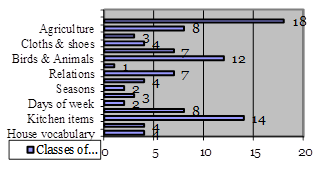
Dhani words agge and piche used for ahead and behind respectively exist in Majhi dialect also. They are used with the same pronunciation and meanings in Majhi.>Nouns form the largest category in every language. Nouns used in the present study were further classified according to different fields. Their detail has been shown in Table 21 below:
Table 21. Classification of Nouns
| S. No width="189" valign="top">Nouns width="146">Frequency width="128">Percentage | > 1 width="189" valign="top">House vocabulary width="146">7 width="128">4 % | > 2 width="189" valign="top">Parts of body width="146">7 width="128">4 % | > 3 width="189" valign="top">Kitchen items width="146">25 width="128">14 % | > 4 width="189" valign="top">Food items width="146">15 width="128">8 % | > 5 width="189" valign="top">Days of week width="146">3 width="128">2 % | > 6 width="189" valign="top">Directions width="146">5 width="128">3 % | > 7 width="189" valign="top">Seasons width="146">3 width="128">2 % | > 8 width="189" valign="top">Ailments width="146">8 width="128">4 % | > 9 width="189" valign="top">Relations width="146">13 width="128">7 % | > 10 width="189" valign="top">Colours width="146">2 width="128">1 % | > 11 width="189" valign="top">Birds and animals width="146">22 width="128">12 % | > 12 width="189" valign="top">Time width="146">13 width="128">7 % | > 13 width="189" valign="top">Clothes and shoes width="146">8 width="128">4 % | > 14 width="189" valign="top">Games width="146">5 width="128">3 % | > 15 width="189" valign="top">Agriculture width="146">14 width="128">8 % | > 16 width="189" valign="top">Miscellaneous width="146">32 width="128">18 % |
The graphical presentation of noun classification in percentage has been given in Figure 3 below:
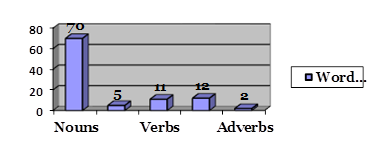
Figure 3
Classification of Noun
 Analysis of the above vocabulary items (260 words) reveals that 20% i-e fifty-one vocabulary items are the same in both varieties but have different pronunciations and 80% i-e two hundred and nine lexical items in one variety have their different alternative in other variety.
Conclusion
According to sociolinguistic studies, language varies from region to region and even person to person. The present study investigated lexical differences between the Dhani and Majhi dialects of Punjabi. The analysis of the data indicates that both varieties have visible differences in the vocabulary items used in daily conversation. These lexical differences of both Dhani and Majhi varieties can be categorized into two groups. 1st group is composed of fifty-one such lexemes as exist in both varieties but differ only in pronunciation, for example, Dhani word ma’ruch ‘pepper’ and Majhi word mirch ‘pepper’ etc. 2nd group consists of two hundred and nine lexemes which are entirely different in both varieties and have their alternative words. Despite dialectal differences, Punjabi leads to the unification of people and promotes wide communication among people in Pakistan because of mutual intelligibility. Language as a controlling force controls the way of thinking. Differences among different varieties exist because people from different cultures have different views of the world because of language that can be summed up in the words of Sapir (1929) as:
“No two languages are ever sufficiently similar to be considered representing the same reality. The worlds in which different societies live are distinct works, not merely the same worlds with different labels”.
References
- Crystal, D. (2008). A Dictionary of Linguistics and Phonetics (6th ed.). USA: Blackwell Publishing Ltd.
- Deáková, J. (2013). Selected Lexical Differences Between British and American English: A Corpus-Supported view. (B.A), Charles University,
- Di Carlo, S. G. (2013). Lexical differences between American and British English: A survey study. Facta universitatis-series: Linguistics and Literature, 11(1), 1-11.
- Grierson, G. A. (1917). The Indo-Aryan Languages. BSOS: 247, 81.
- Hallberg, D. G., O'Leary, C. F., Backstrom, P. C., Radloff, C. F., Decker, S. J., Decker, K. D., & Rensch, C. R. (1992). Sociolinguistic Survey of Northern Pakistan. NIPS: Islamabad.
- Hasan, W., & Khan, A. A. (2019). Phonological Analysis of English Loanwords in Dhani. International Journal of English Linguistics, 9(6), 198.
- Hudson, R. A. (1996). Sociolinguistics: Cambridge University Press.
- Jamshaid, R. (2016). Lexical Variation among Punjabi Dialects as a Marker of Linguistic Boundaries in Pakistani Punjab. Linguistics and Literature Review, 2(2), 117-142.
- Mahmood, K. (2010). Map of Dialects of Punjabi Language. In Own work (Vol. 682 × 624). 5 December 2010.
- Mathai, E. K. (2011). Bagri of Rajasthan, Punjab, and Haryana, 47.
- O'Grady, W., Archibald, J., Aronoff, M., & Rees- Miller, J. (2001). Contemporary linguistics. Boston: Bedford. In: St. Martin's Press.
- Petyt, K. M. (1980). The study of dialect: An introduction to dialectology: Westview press.
- Rahman, T. (2006). Language policy, multilingualism and language vitality in Pakistan. Trends in linguistics studies and monographs, 175, 73.
- Sanyal, D. (2013). A Comparative Analysis of Lexical Variation in American and British English with special reference to a few selected words. Rupkatha Journal on Interdisciplinary Studies in Humanities, 5(3).
- Sapir, E. (1929). The Status of Linguistics as a Science. Language, 5(4), 207-214.
- Shareah, M. A. Q. A., Mudhsh, B. A. D., & AL- Takhayinh, A. H. (2015). An Overview of Dialectal Variation. International Journal of Scientific and Research Publications.
- Simons, G. F., & Fennig, C. D. (2017). Ethnologue: Languages of the world. SIL International.
- Strevens, P. (1972). British and American English: Macmillan Pub Co.
- Tariq, M. (2012). Major Punjabi Dialects. The News Tribe website:
- Trudgill, P., & Hannah, J. (2002). International English: A Guide to Varieties of Standard English: Arnold.
- Waseem, B. (2017, July 2). Introduction to Dhani. Waseem, B. (2017, July 2). Introduction to Dhani.
Cite this article
-
APA : Hasan, W., & Khan, A. A. (2021). Study of Lexical Variation between Dhani and Majhi Punjabi. Global Language Review, VI(IV), 1-16. https://doi.org/10.31703/glr.2021(VI-IV).01
-
CHICAGO : Hasan, Wasim, and Arshad Ali Khan. 2021. "Study of Lexical Variation between Dhani and Majhi Punjabi." Global Language Review, VI (IV): 1-16 doi: 10.31703/glr.2021(VI-IV).01
-
HARVARD : HASAN, W. & KHAN, A. A. 2021. Study of Lexical Variation between Dhani and Majhi Punjabi. Global Language Review, VI, 1-16.
-
MHRA : Hasan, Wasim, and Arshad Ali Khan. 2021. "Study of Lexical Variation between Dhani and Majhi Punjabi." Global Language Review, VI: 1-16
-
MLA : Hasan, Wasim, and Arshad Ali Khan. "Study of Lexical Variation between Dhani and Majhi Punjabi." Global Language Review, VI.IV (2021): 1-16 Print.
-
OXFORD : Hasan, Wasim and Khan, Arshad Ali (2021), "Study of Lexical Variation between Dhani and Majhi Punjabi", Global Language Review, VI (IV), 1-16
-
TURABIAN : Hasan, Wasim, and Arshad Ali Khan. "Study of Lexical Variation between Dhani and Majhi Punjabi." Global Language Review VI, no. IV (2021): 1-16. https://doi.org/10.31703/glr.2021(VI-IV).01